Isolated – Isolationserfahrung Geflüchteter Menschen in Brandenburger Gemeinschaftsunterkünften
(4 Folgen)
Paula Küntzel & Jakob Tuchelt
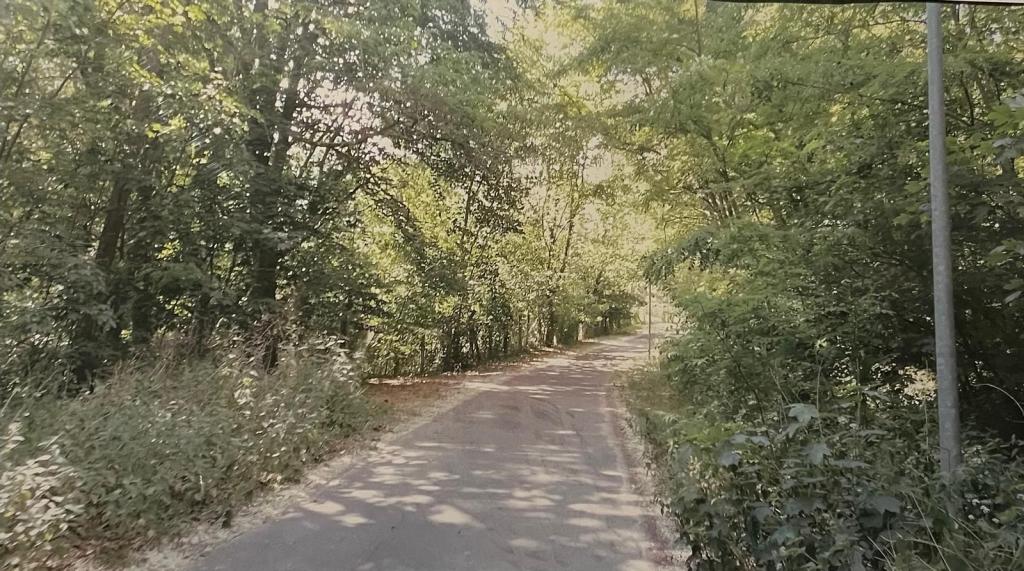
Dieses Bild hängt mit folgender Bildunterschrift im Refugees Emancipation Community Center:
This is what the road to the Kunersdorf camp Looks like. The Trip from Potsdam takes between 3hrs. and 4hrs. When you arrive at the nearest bus Station you habe to walk around 20 minutes to reach the camp. The last bus to leave the area leaves at 6pm.
So sieht der Weg zum Kunersdorfer Heim aus. Die Fahrt von Potsdam dauert zwischen 3 und 4 Stunden. Wenn man an der nächst gelegenen Bushaltestelle ankommt, muss man noch etwas 20 Minuten laufen, um das Heim zu erreichen. Der letzte Bus, der die Gegend verlässt, fährt um 18:00.
[…] not only […] refugees are isolated from the communities. The communities are also isolated from the refugees. It works both ways. the asylum system sort of like puts a barrier. It puts a border.”
Fiona Kisoso (Refugees Emancipation e.V.) im Interview.
Die öffentlichen Debatten zum Thema Flucht und Migration erhalten insbesondere seit 2015 viel Aufmerksamkeit. Was dabei jedoch häufig außen vor bleibt sind die Stimmen von Geflüchteten selbst. Im Rahmen des studentischen Forschungsprojekts Isolated – Isolationserfahrung Geflüchteter Menschen in Brandenburger Gemeinschaftsunterkünften berichten Geflüchtete von ihren Perspektiven. Wir werfen in den Interviews einen Blick auf die Isolationserfahrungen, die Geflüchtete in Gemeinschaftsunterkünften machen. Dabei wird klar: nicht nur die Geflüchteten sind von der deutschen Gesellschaft isoliert, sondern auch andersherum die deutsche Gesellschaft von den Geflüchteten. Isolationsmechanismen wirken in beide Richtungen.
Die Erfahrungen der Geflüchteten, mit denen wir gesprochen haben, werden in vier unterschiedlichen Folgen hörbar gemacht und wissenschaftlich eingeordnet. Dabei geht es thematisch um räumliche Isolation (Folge 2), psycho-soziale Isolation (Folge 3) und Isolation von Information (Folge 4). Die erste Folge dient als Einführung in das Thema und wurde sowohl auf deutsch als auch auf Englisch aufgenommen. Die restlichen Folgen sind nur englischsprachig.
Unter räumlicher Isolation (Folge 2) verstehen wir alle räumlich-infrastrukturellen Aspekte der Isolation, zum Beispiel Isolationserfahrungen, die Unterbringung, Lage und Anbindung von Geflüchteten und Geflüchteten-Unterkünften betreffen. Diese zeigt sich vor allem durch die abgelegenen Wohnheime für Geflüchtete und fungiert sowohl als Form der Isolation Geflüchteter von der deutschen Zivilgesellschaft als auch andersherum.
Als psycho-soziale Isolation (Folge 3), bezeichnen wir all die Aspekte der Isolation, die soziale Kontakte, körperliche und psychische Gesundheit, Hoffnungen, Selbstverwirklichung und Lebensgestaltung (z.B. in Bezug auf Sprachkurse und Arbeitsmarktchancen) betreffen. In dieser Folge kommt besonders stark zur Geltung, wie die Isolation auf Geflüchtete wirken kann und wie verwoben ihre verschiedenen Aspekte sind.
Die Isolation von Informationen (Folge 4) meint die Erfahrungen, die mit dem (Nicht-)Erlangen von für die Geflüchteten relevanten Informationen zusammenhängen. Dies können beispielsweise Informationen über den Aufenthaltsstatus, Sprachkurse, Arbeitsmöglichkeiten und soziales Leben sein. Diese essentiellen Informationen sind teils in den Unterkünften und der erreichbaren Umgebung nicht verfügbar; gleichzeitig ist auch der Fluss von Informationen nach Außen stark gehemmt.
In allen drei Folgen zeigt sich, wie groß die Bedeutung von rechtlichen und institutionellen Hürden und Barrieren (legal block) auf der einen Seite und Rassismus-Erfahrungen, Ausgrenzungen und Vorurteilen (mental block) auf der anderen Seite sind, die die Isolation von Geflüchteten wesentlich mitbestimmen und aufrechterhalten.
Mit dem Podcast wollen wir einen Beitrag dazu leisten, Informationen aus den Geflüchtetenunterkünften herauszutragen und somit das Wissen in der deutschen Gesellschaft über die Isolationserfahrungen Geflüchteter zu vergrößern. Im Zentrum unseres Beitrags stehen daher die Erfahrungen von vier Geflüchteten und wie sie diese selbst einordnen.
[…] at the end of the day, I am me. I can’t be you.I am Black.I cannot turn into white to please you.At the end of the day, I have my own personality.I have my own person.I am my own person.
Ana (anonymisiert) im Interview
Das Projekt wurde in enger Zusammenarbeit mit Refugees Emancipation e.V.[1] durchgeführt. Unser Dank richtet sich besonders an Fiona Kisoso, Immaculate Chienku, Louise Nzele und Eben Chu. Ohne ihre Beiträge und Hilfe wäre das Projekt nicht umsetzbar gewesen.
[1] Refugees Emancipation e.V. ist eine politische Organisation, die von Geflüchteten gegründet und organisiert ist. Ihr Ziel ist es, sich über viele verschiedene Wege für eine Verbesserung der Lebenssituationen Geflüchteter in Deutschland, spezifisch Brandenburg, einzusetzen.
Folge 1: About „Isolated“
Transkript des Audios
Podcast-Script: Isolated– Isolationserfahrungen von Geflüchteten in Brandenburger Unterkünften Ein Podcast von und mit Paula Küntzel und Jakob Tuchelt
Folge 1: About “Isolated” Teaser: [Fiona]: “Having have lived in a von Heim for maybe, It sort of feels like you’ve been frozen in time. You cannot really move forward. You cannot move back. You’re stuck in a place.” [Ana: “you’re not allowed to do anything. You’re not allowed to, you’re not allowed to maybe move away from the camp.” [Theo]: “Most of the time, I’m alone. I´m alone. When I go to school, I come back. I’m always alone” [Ana: “as much as people have issues they’re dealing with, but the camp is not helping much” [Fiona]: “you’re qualified you went to school you have so much to offer that doesn’t matter” [Theo]: I must start the course in February. So I lost one year. (..) I didn’t do anything. [Fiona]: “the isolation is not only one way that refugees are isolated from the communities. The communities are also isolated from the refugees. the asylum system sort of like puts a barrier” Einleitung [Auto rauschen] [Paula]: Wir fahren in das tiefe Brandenburg, dort wo wir hinfahren, liegt eins der vielen Camps, in dem Geflüchtete während ihres Asylverfahrens wohnen. Unser Plan ist heute unsere Interviewpartner*innen für diesen Podcast kennenzulernen. [Jakob]: Aber erst einmal: wer sind wir überhaupt? Wir, sind zwei Soziologiestudierende der Uni Potsdam, die euch durch diesen Podcast leiten werden. Ich bin Jakob. [Paula]: Und ich bin Paula und wir heißen euch herzlich willkommen zu unserem Podcast Isolated- Ein Podcast über die Isolationserfahrungen geflüchteter Menschen in Brandenburger Unterkünften. [Jakob]: Diese erste Folge soll euch einen allgemeinen Eindruck auf unser Thema verschaffen und bereits einige Hintergründe beleuchten. In den Folgen 2,3 und 4 sprechen wir dann über verschiedene „Typen“ oder Aspekte von Isolation: Physische Isolation, Psycho-Soziale Isolation und in der letzten Episode über die Isolation von Informationen! Im Dezember letzten Jahres lebten 16.586 Geflüchtete in Gemeinschaftsunterkünften und 335 in vorübergehenden Unterkünften in Brandenburg. Für diesen Podcast haben wir mit 4 von diesen Menschen Interviews aufgenommen, die wir zu ihren persönlichen Erfahrungen befragt haben. Außerdem haben wir ein Interview mit Fiona Kissoso und Imma Chienku aufgenommen, die aus ihrer professionellen Erfahrung über dieses Thema sprechen können. [Paula]: Ein paar der Interviews in dieser Folge wurden auf Englisch geführt, ab etwa der Mitte dieser Folge werden wir daher auf englisch sprechen. Der Podcast wird außerdem ab der zweiten Folge dann ganz auf Englisch stattfinden. Aber zurück zu unserer Reise: Nach Brandenburg mitgenommen werden wir von Imma und Fiona, die wir eben schon erwähnt haben. Beider arbeiten beim Verein Refugees Emancipation. Das ist eine politische Organisation, die von Geflüchteten selbstorganisiert ist und sich über viele verschiedene Wege für eine Verbesserung der Lebenssituationen Geflüchteter in Deutschland einsetzt. Wenn ihr mehr über die Organisation erfahren wollt, schaut gerne auf Facebook und Instagram nach und hört in den Podcast unserer Kommilitoninnen Emma und Leonie rein. Im Geflüchteten Camp angekommen, lernen wir nicht nur zwei unserer späteren Interviewpartner kennen, sondern im Kontext von Refugees Emancipation sprechen wir auch mit ihnen und weiteren 5 Bewohnern über ihre Situation vor Ort und im Asylverfahren. Direkt danach unterhalten wir uns über das Treffen: Reise: [Rückblende zu Audioaufnahmen von uns, direkt nach dem Besuch in dem Heim] [Jakob]: Gerade sind wir in Rathenow. (..) Wir sind anderthalb Stunden oder eine Stunde mit dem Auto hergefahren. Durch ganz dichten Nebel. (..). [Paula]: Am Eingang mussten wir unsere Personalausweise abgeben. Also zumindest vorzeigen. Dann haben wir alle einen Besucher:innenausweis bekommen. [Jakob aus dem off]: Wir fragen Imma auf der Rückfahrt, warum diese formale Anmeldung erforderlich ist: [Imma im Auto]: warum man das machen soll, weiß ich nicht. Ja. Aber, (..) ich habe mich auch nie richtig gefragt, warum, aber vielleicht bin ich einfach gewöhnt, dass es so passiert in 99 von Unterkünften, dass sie einfach mal wissen wollen, wer reinkommt und wer rausgeht. (.) Ja. Aber warum macht man sowas? (..) Das weiß ich nicht. (.) das ist immer eine Frage von Sicherheit, vielleicht von der Heimbetreiber. Dass das sind so gefährliche Orte, wie wir immer bei Refugees Emancipation das nennen. Es ist kein normaler Ort, weil du siehst, normaler Ort muss man sich nicht ausweisen. Ja. Aber das sind, in Einführungszeichen, gefährliche Orte, muss man gucken, wer da reinkommt. Es ist ein Kontrollmechanismus, (.) glaube ich. [Jakob aus dem off]: Wir haben also am Eingang unsere Personalien abgegeben. [Paula]: Ja, und dann sind wir hochgegangen in ein Zimmer, was sehr… (.) Sehr klein. Sehr klein ist. Drei Betten. Sehr spärlich eingerichtet. das sah eigentlich so aus wie… Ich habe drei Sachen und ich bin gestern hier angekommen. [Jakob]: Ja, da war kein Kleiderschrank. Oder irgendwas war… [Paula]: Gar kein Schrank. [Jakob]: Ein Tisch und drei Betten waren da drin, ja. [Paula]: Das Fenster ging nicht auf. (.) [Jakob]: Aber es gab eine Herdplatte. [Paula aus dem off]: In diesem Zimmer hatten wir dann unser Treffen mit ca. 7 Interessierten Bewohner:innen der Unterkunft. [Jakob]: Hättest du damit gerechnet, dass sich jetzt so viele Leute erstmal prinzipiell bereit erklären, mitzumachen? (…) [Paula]: Ich habe da gar nicht so drüber nachgedacht, muss ich sagen. [Jakob]: Ich habe voll viel drüber nachgedacht. (.) [Paula]: Also ich hatte auch den Eindruck, was ich schön fand, dass die Leute sich auch relativ sicher gefühlt haben, so Sachen von sich zu teilen. Ich schätze mal auch ganz viel dadurch, dass Ima und [Fiona] dabei waren, die ja auch selber nicht weiß-deutsch sind, sondern auch selber natürlich da. [Jakob]: Das habe ich die ganze Zeit gedacht, wenn die nicht da wären, wir wären sowas von aufgeschmissen gewesen. [Paula]: Ja, also verständlicherweise ist es ja viel leichter, sich jemandem zu öffnen, von dem du weißt, der hat irgendwie vielleicht ähnliche Erfahrungen gemacht wie ich und der weiß ein bisschen, wie es auch sein kann. Und das können wir beide ja gar nicht wissen. [Jakob aus dem off]: An dieser Stelle ist es vielleicht angebracht zu sagen, dass wir beide, [Paula] und ich, weiß sind und, wie unsere Eltern, in Deutschland geboren und aufgewachsen sind. Dementsprechend mussten wir noch nie die Erfahrung machen, dass Rassismus unser Leben oder unseren Alltag in irgendeiner Weise einschränkt. [Paula aus dem off]: Wir fragen auch Imma und Fiona nach ihrem Eindruck von unserem Besuch. [Jakob]: Wie war sonst euer genereller Eindruck? Oder dein Eindruck? [Imma]: Mein Eindruck, also, hat mir gut gefallen, weil, (..) normalerweise sind die Geflüchtete sehr, sehr ängstlich. Sie, sie gucken immer mit, ähm, Vorsicht, (.) wer, wer, wer seid ihr? Ähm, soll ich versagen? Soll ich meinen Namen? Das kann, manchmal ist es sehr unterschiedlich. Du kommst in eine Unterkunft und die Leute, sie kommen zwar, aber, sie gucken sich sehr merkwürdig, (.) […] es ist nicht immer so, dass die Leute kommen und sich öffnen. Weil, mit diesem Asylsystem ist sehr viel Angst verbunden. Man weiß nicht, wer. (.) Dann, es sind immer Gerüchte, sie sind Leute von der Regierung. Vielleicht, wenn du gehst, ähm, du sagst deine eigene oder deine richtige, ähm, ähm, Daten, und dann wirst du dann abgeschoben. Aber, hier habe ich gesehen, die Leute waren offen. [Paula]: Was sind dann noch für Ängste hinter? Also, abgeschoben zu werden. Gibt es noch andere Ängste? (.) [Imma]: Ähm, (…) die abgeschoben, (….) ja, ich glaube, das ist das, am meisten von den Ängsten. Genau. Ähm, vielleicht kriege ich kein Geld mehr. Ich fürchte um meine Existenz hier. Ich möchte kein Problem. Ähm, meine Situation ist zwar nicht gut, aber, ähm, wie man immer sagt, lass die liegenden Hunde schlafen. [Paula]: Also möglichst nicht auffallen, und so den Kopf runterhalten, um möglichst keinen Stress zu bekommen. [Imma]: Genau, Ja! [Paula]: And Fiona, what were your impressions of the visit? [Fiona]: yes um from our our visit today you notice there was no women yeah already so you can already see the degradation of just how much that lifestyle in the heim affects people in different um at different levels there’s gender there’s you know. So women actually, they fall through the cracks they’re they’re more marginalized yeah there’s you know there’s a degradation from just being a refugee to being an african refugee woman living in isolation in brand new book has repercussions and you see that today because we actually did not see one. Not even in the compound yeah not even on the Treppenhaus at all like when we’re coming up you don’t see them at all so you ask yourself where are they? [Paula]: what do you think where they are? [Fiona]: they’re taking care of their children or like maybe they are in depression or maybe they are so afraid that things spaces like this they feel like it’s not for them. I’m sure [Name] did not just call men. Or even if he did these other ones already could have called the women they know who live in the heim, but there must be uh something at play here. I mean, it’s not a long time ago we were here. For me, what a little bit shocks me is just how low the mood of the people is. They’re not positive and they don’t have information about their status. They feel isolated information-wise. That for me was a little bit negative. It didn’t feel good to see it like that. But it gives me a positive impression to see that they want to make the situation better. They want… Another thing is I also did not like that we still have this control to give our Ausweises and what not. Because for me it means that the practice to make refugees look like their lives are dependent on their stay here on like their administration. The administration have all the say on their lives. Aufbau des Podcasts – Was wir von der Reise mitgenommen haben [Jakob]: From now on our moderation will also proceed in english. During our first visit and the conversation with Imma and Fiona afterwards, we identified 3 Types of Isolation. In a separate Interview Fiona called them physical isolation, psychosocial isolation and isolation from information [Paula]: So, with these categories in mind we will look at our interviews in the next few episodes. In the next episode “physical isolation” we will talk about the circumstance, that a lot of Refugee Camps in Brandenburg lie remote, far away from possibilities of public transportation and often in areas with a bad network and internet connection. We will also talk about restricted legal possibilities to move and the signal, that is given to the german public by all those forms of physical isolation. [Jakob]: In the third episode, “psychosocial isolation” we will look more closely at the psychic and social effect of isolation on refugees. We will deal with the following topics: feeling of lonelyness and belonging, personal relationships, and mental and physical health. But also we will talk about how an experience of racism affects everyday life and security. Through this we want to show the connection between isolation and its mental consequences. [Paula]: The fourth and final episode deals with the isolation of information. Refugees often have limited or no access to essential sources of information. The consequences of this, which important hubs are emerging and who is particularly affected, are our topics in episode number four. [Jakob]: So, as you can hear, we have a lot planned. You can listen to all of these episodes separately; we have produced them in such a way that they can be understood independently. But of course, all of these aspects are connected and together create a bigger picture. [Paula]: And that brings us to the end of this first overview episode. [Jakob]: We hope we’ve sparked your interest. Until then— We see you in the next episode. [Both]: Bye Bye. Ending [Ana: “at the end of the day, I am me. I can’t be you. I am black. I cannot turn into white to please you. At the end of the day, I have my own personality. I have my own person. I am my own person. So, really, for me, I don’t, I don’t, um, really think so much about it. But, of course, when it happens, yes, there’s a way you feel. You can’t deny that.” [William]: Je voudrais que les Allemands et les étrangers vivent comme des frères. (.) Et n’aient pas de haine. Peut-être pour quelque chose qui s’est passé il y a 100 siècles. (…..) [ENG]: I want Germans and foreigners to live as brothers. (.) And not to hate each other. Perhaps for something that happened 100 centuries ago. (…..) Acknowledgements [Paula]: We would like to thank: Refugees Emancipation for their tremendous support of the project, the connections, and their work. Special thanks go to: Fiona Kisoso, Immaculate Chienku, Louise Nzele, and Eben Chu We also thank our interview partners: Ana, Stephane, Theodore, and William for their trust and cooperation! Thanks to Tobi, Theo and Anna for the voice-over. A big thank you to Yohane Nkuibo, Max Guggenheim and Deirde Winter for translating the French interviews. For mixing and technical assistance, we thank Johannes Tuchelt [Jakob]: Isolated is a podcast produced by Paula Küntzel and Jakob Tuchelt in cooperation with Refugees Emancipation, for the Department of Social Structure Analysis at the University of Potsdam.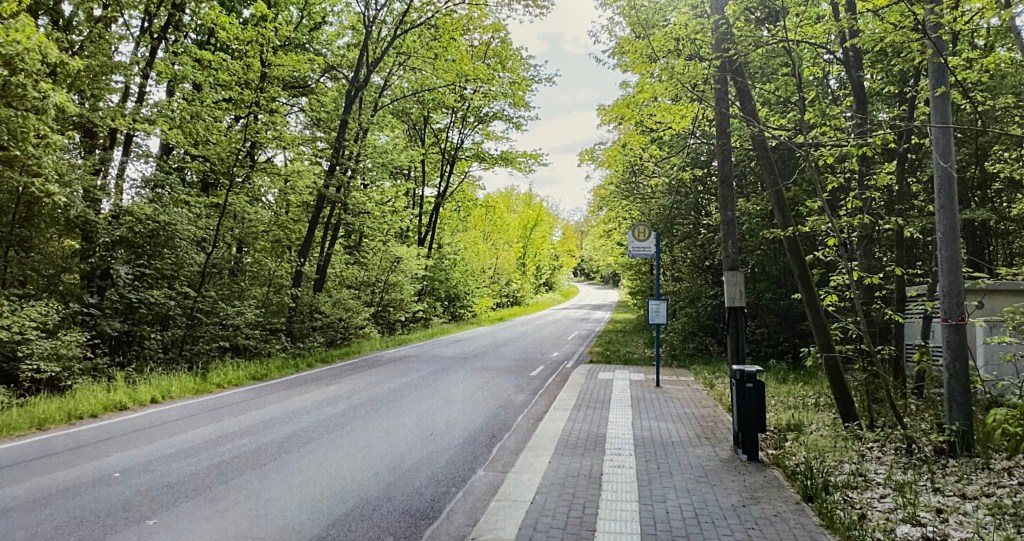
Dieses Bild hängt mit folgender Bildunterschrift im Refugees Emancipation Community Center:
To reach Hohenleipisch you have to travel between 3.30hrs and 4hrs. The road is lonely and there is no easy access to Services such as supermarkets, pharmacies, doctors, educational centers, etc. A group of refugees were traveling from this camp to Potsdam to have to german, i. e., 8 Hours of daily travel for three months. Can you imagine yourself doing this every day?
Um Hohenleipisch zu erreichen, muss man zwischen 3.30 und 4 Stunden fahren. Die Straße ist verlassen und es gibt keinen einfachen Zugang zu Dienstleistungen wie Supermärkten, Apotheken, Ärzten, Bildungszentren usw. Eine Gruppe von Geflüchteten reiste von diesem Heim nach Potsdam, um dort Deutschunterricht zu nehmen, d. h. sie waren drei Monate lang täglich 8 Stunden unterwegs. Können Sie sich vorstellen, das jeden Tag tun?
Folge 2: Physical Isolation
Transkript des Audios
Podcast-Script: Isolated– Isolationserfahrungen von Geflüchteten in Brandenburger Unterkünften Ein Podcast von und mit Paula Küntzel und Jakob Tuchelt
Folge 2: Physical IsolationTeaser:
[Fiona]: “to be a woman or a child a refugeeliving in those isolatedjoint accommodations (..) is (….) it’s it’scapital offense if you ask me (.)” [Ana]: “you’re just, you’re in your room, you’re sharing a room with maybe eight other people, five other people, youre just in your room” [Theo]: “we have problems with trains and buses. At 8, 9 or 10, if you don’t get the possibility to come back, it is not easy for you to come back” [Fiona]: “the neighborhood and the towns where these von Heims are, (.) there’s a feeling that they’re over there, they’re hidden, that place far, because they’re dangerous. “ Introduction: [Paula]: Welcome back to episode 2 of our Podcast Isolated- a Podcast about isolation experiences of refugees in Brandenburg. I’m Paula. [Jakob]: And I am Jakob, and we study sociology at the university of Potsdam.. Looking Back into the last Episode: [Paula]: In the last episode we talked about our trip to a Refugee Camp and our impressions from that visit and we gave a general overview on our podcast topic. [Jakob]: Today, in the second episode, we will deal with the topic of physical isolation. We are going to talk about aspects of how and where Refugee Camps are located and about the impact and bigger meaning of physical isolation. Paula: All people we interviewed for this podcast on their personal experiences were anonymized by us and are being referred to under a fake name. We also want to address that both Jakob and me are white and, like our parents, were born and raised in Germany. Accordingly, we have never had to experience racism restricting our lives or our everyday routines in any way. Topic of this Episode [Jakob]: In this episode we will talk about physical isolation, specifically about moving between the different camps, in what ways a camp can be a home, spatial isolation, public transportation and the room situation within the camps [Paula]: Many refugees have to change their assigned place of residence multiple times within a short period of time, as was the case with Theodore: [Theo]: “I was arrived in Germany in 2022, 22, yeah. My first staying is in Eisen. I lived in Eisen two or three weeks after I was transferred in Frankfurt-Oder. In Frankfurt-Oder, I lived during four months after I was transferred in Premnitz in Brandenburg here.” [Jakob]: One First Reception Centre in the State of Brandenburg is located in Eisenhüttenstadt. Asylum seekers are accommodated in a first reception centre during the first few weeks of their asylum procedure. The actual asylum procedure itself is carried out by the Federal Office for Migration and Refugees (BAMF) in Eisenhüttenstadt. [Paula]: So that means: the state of brandenburg is only responsible for accommodation and basic care while the state germany is responsible for the asylum process. [Jakob]: law defines that Asylum seekers are distributed among the districts and independent cities after spending a maximum of six months in the first reception centre. However, this law is not always being adhered to: [Jakob]: “How long have you been in Germany or in a camp?” [Ana]: “I’ve been in Germany now for one year, one year, four months now. (..)I was in the first reception center for 14 months. (…..) Okay. (….)” [Jakob]: Unfortunately, we were unable to find official data on the mobility of women and children or on the mobility of people with temporary residence permits. We searched specifically for this information because we were told in the interviews that women and children tend to stay in the accommodation longer than men. [Paula]: What we were able to find is general data regarding the History of assinged shelter: A Study caried out by the Federal Ministry of Migration and Refugees published in 2022 collected data from refugees who came to Germany from 2013 – 2016. The survey took place in 2019 finds the following: Half of the initial moves from first reception centers to shared accommodations took place within the first 3 months after arrival (50%). For just under 40% of respondents, however, the first move takes longer than six months, and for 30% it takes a year and a half or longer. These figures correspond to the experiences shared with us by our interview partners. [Jakob]: How many refugees are being distributed to a federal state is determined by the so called Königsteiner Schlüssel. In Brandenburg thats three percent of the asylum seekers who came to Germany in the first place. At the first reception center, refugees undergo medical examinations before being distributed further. In the first reciption center the federal states are responsible for accomodation and basic care. After the stay in the first reciption center the responsibility of accomodation and care shifts to the districts and independent cities. Responsibility is therefore passed down. Except for the asylum procedure itself. Which, like already said, remains in responsibility of the federal level, meaning the state of germany. [Paula]: Refugees Cannot participate in the decision of where to live. Once they arrive in a federal state, the responsible authorities assign accommodation to the refugees. Stephane talks about this allocation of a home by the authorities. [Stephane]: “Non, mais pour l’isolement, il y a l’isolement. Parce que je suis toujours seul. Il faut que j’aille chercher le petit, là. C’est pour ça que je viens à Berlin. Moi, si ce n’est que moi, je ne devrais pas vivre à [Rathenau], moi. C’est parce qu’on ne peut pas décider, parce qu’on est en asile. Quand on voit que tu es obligé de partir, c’est ça. Sinon, quand je suis là-bas… c’est pour ça que je reste chez moi. Parce que je n’ai pas où partir, je suis isolé. » [ENG] No, but as regards the isolation, there is isolation. Because I am always alone. I have to go and find the boy, there. That’s why I come to Berlin. If it was just up to me, I wouldn’t live in [Ort]. It’s because you can’t decide because you’re in asylum. When they see that you have to leave, it’s that. Otherwise, when I’m there … that’s why I stay at my place. Because I haven’t got anywhere to go, I’m isolated. [Paula]: The allocation of a home is usually accompanied by restrictions on freedom of movement. [Fiona]: “a lot of people get ausweise with restrictions for movement. there was this, what they had, a residence fleeced, which was lifted. But because it was, it was lifted does not mean people still feel secure. You can just change a law, but then you don’t really let the people know, hey, you’re free” [Jakob]: Fiona refers to ‘residenzpflicht,’ which translates to ‘spatial restriction.’ Specifically, this means that as long as refugees are required to live in a reception centre, the so-called residenzpflicht applies. This is a curfew. Only when they are no longer required to live there, but no later than after three months, does this spatial restriction end. [Paula]: For refugees, this means that they need permission to leave the district of the responsible immigration authority. There must be compelling reasons for leaving. If refugees have to go to lawyers, authorities or courts and their personal appearance is required, an exception is made. [Ana]: “Yeah, you’re not allowed to do anything. You’re not allowed to, you’re not allowed to maybe move away. from the camp. At Eisen, you’re not allowed to be outside for more than 24 hours. You know, Eisen is really far from here.” [Paula]: The restriction applies to refugees who are seeking asylum in Germany but whose asylum application has not yet been processed, and to tolerated persons. The Interviewees also tell us how it feels for them, living in their heim. By Heim the refugee accomodation is meant. [Stephan]: “Donc je veux juste dire en conclusion, on peut dire que… il faut voir que la majorité des Camerounais qui sont là-bas ne vivent pas dans le Sozialheim, parce que le Heim c’est ta maison. C’est quand tu es en Allemagne, quand tu es dans le Heim, le Heim c’est ta maison. Ça veut dire que tu n’as pas une autre maison en dehors du Heim, le Heim c’est ta maison. Alors tu ne peux pas être chez toi, tu es mal à l’aise. Il faut que tu viennes à Berlin pour te défouler un peu, pour aller voir les amis, ou bien peut-être aller dormir chez un de tes amis, parce que tu n’es pas à l’aise chez toi. [ENG] So I’d just like to say, to conclude, one can say that … you have to see that most of the Cameroonians who are there don’t live in the heim, because – the heim is your home. It’s, when you’re in Germany, when you’re at the heim, the heim is your home. That means that you don’t have anywhere else to live apart from the heim, the heim is your home. So you can’t feel at home, you don’t feel comfortable. You have to come to Berlin to relax a bit, to visit friends, or perhaps to stay overnight with one of your friends, because you don’t feel comfortable when you’re at home. [Jakob]: However, camps can also be perceived as places of balance, if they are well run. This is the case with Ana. [Ana]: So, I mean, most of the time you feel really uncomfortable when you’re in public places, but maybe when you’re in the camps where you’re blacks or you have other, more black people, then it feels a little bit easier. When you get outside, it’s really, it feels really awkward. It’s easier because you have your other black people and I would say the socials of the camps are a little bit helpful. (..) Yeah. (..) So, it’s kind of easy at the camps, but when you get outside, really it’s difficult. Okay. [Jakob]: All of our interviewees reported feelings of isolation and exclusion as well. Stephane, among others, told us how this has affected him. [Stephan]: “Je suis obligé de venir à Berlin tous les jours pour me sentir un peu à l’aise. Parce que quand je rentre là-bas, il faut seulement dormir. Faire quelque chose à manger, dormir, c’est tout. C’est quand je suis à Berlin que je sens un peu (…) que peut-être tu vis. Sinon, là-bas, il n’y a pas une vie. [ENG] I have to come to Berlin every day to feel a little at ease. Because when I go back there all I have to do is sleep. Make something to eat, sleep, that’s all. It’s when I’m in Berlin that I feel a bit (…) that you can have a life, perhaps. Otherwise, there, there’s no life. [Paula]: Discrimination and not feeling welcome at the accommodation have been brought up in almost every interview we took. However, discrimination is not only linked to the heim. Ana and William shared two experiences of everyday racism with us that happened to them while using the public transport: [Ana]: Another thing I would say is, sometimes, maybe, when you’re in the trains or in the bus, and, for me, I would say, like, I have my monthly ticket in my phone. So, sometimes, maybe the phone is a little bit slow, or it’s not opening the ticket, and the control comes, and you’re trying to tell them it’s a little bit slow, and, like, they feel like you don’t have the ticket, and you’re just doing this to, to maybe make them go away,or just, like, they’ve already have, you feel like they’ve already have a perception about you as a black person. So, maybe they feel you don’t pay the tickets, you’re always, like, they always feel like you, you always do everything wrong. [William]: “Oui. Déjà, une fois je rentrais de l’école, j’ai emprunté un bus au niveau de Berlin pour me déposer à l’école. À un stop, il y a une dame qui est entrée dans le bus. Et elle ne savait pas que je comprenais ce qu’elle me disait. Elle a parlé de me faire… que je quitte la place pour qu’elle puisse s’asseoir. Mais je ne l’ai pas regardée, je ne lui ai pas non plus parlé, je n’ai rien dit. Pourtant il y avait plusieurs personnes auprès de moi, elle ne leur a rien demandé. Et j’ai ressenti ça un peu comme, euh… T : …un peu raciste. W: Oui. T : Parce que tu étais le seul Noir. W: Oui, comme si j’étais très supérieur [gemeint ist wohl „comme si j’étais le tout premier à entrer en ligne de compte“] pour que ELLE s’asseye, pour que je doive me lever, quoi. T : Elle était venue directement vers toi pour te dire… W : Oui, vers moi, oui. T : Et dans le bus tu étais le seul Noir W : Bon, j’étais pas le seul Noir, mais j’étais le seul Noir assis, quoi.” [ENG]: “Yes. Once I was coming home from school, I got a bus in Berlin to get me to school. At one stop there was a lady who got on the bus. And she didn’t know that I understood what she was saying to me. She said that I … that I should give up my seat so that she could sit down. But I didn’t look at her and I didn’t speak to her either, I didn’t say anything. And yet there were several people sitting near me, she didn’t demand anything of them. And I felt that was a bit like, uhh … T: …a bit racist? W : Yes. T : Because you were the only Black person. W : Yes, as if she had singled me out so that SHE could sit down, so that I would have to get up, know what I mean? T : She came straight up to you to tell you … W : Yes, up to me, yes. T : And you were the only Black person on the bus W : Well, I wasn’t the only Black person, but I was the only Black person who was sitting down.“ [Paula]: The discrimination experienced by refugees often has serious mental consequences. There is a direct connection between physical isolation and psychosocial isolation here. we will also talk a little more about the effects of everyday racism on the feelings of our interviewees in our next episode. [Jakob]: we will hear about the meaning of public transport for refugees that live in physically isolated Shelters In a moment. But before that, Fiona explains to us in detail how isolated the Shelters are and what effects this has. [Fiona]: “So with the physical isolation, it’s not only being removed from possibilities of integration with normal German societies so that they can go shopping, go to schools, go to German classes. (..) And that takes a little bit extra work for them to access from the physical isolation, which is stressful already because, I mean, if you go and stick people in the middle of nowhere and they are foreign to that country, first of all, then it takes them much more sort of mental energy and physical energy to reach just normal, everyday life things” Paula: Fiona also talks about the actual distance between the shelters and the rest of society, emphasising the consequences. [Fiona]: “I think the closest (..) house from my von Heim was probably I want to say maybe three kilometres and it’s somebody’s holiday home so they were never there (..) the neighbourhood and the towns where these von Heims are, (.) there’s a feeling that they’re over there, they’re hidden, that place far, because they’re dangerous. (..) or they’re not ready to integrate or you are not supposed to integrate with them or even socialize with them. so you have done nothing but that feeling comes from why did the government choose that place so already the German has been isolated by the government by making him think that hey this place is so far it’s removed from the rest of the German communities and societies it’s good for this kind of people let’s put them there but just by mistake you are a neighbour (..) so you see the sociological impact so German people then think it’s so far away here must be a reason for it probably because it isn’t safe. And you see it’s a recurring theme it happens over and over and over again it’s not special to certain cities every town you go to in Brandenburg the Wohnnheims are very isolated so it’s logic to just think oops these are not very safe areas it’s not (..) very safe so let’s put them far from societies yeah” [Jakob]: Fiona pointed out that the residences are kilometres away from the train station and other houses. Theodore told us about having problems with the connection to public transport. He told us that he went to visit a friend living somewhere else in brandenburg, which became a huge problem in the end. [Theo]: “we have problems with trains and buses. At 8, 9 or 10, if you don’t get the possibility to come back, it is not easy for you to come back Because the last train is at 8 or 10. After 10, you don’t get the train. The bus comes at 10, 11 and 12. But sometimes you can’t see any bus. Once I went to visit my friend in Rathenau, I finished with my friend because we had an exercise to do together. (.) I finished around 10. I must take the bus to come to Bahnhof. In Bahnhof, I will take the train. The last train left, so I must take the bus. (..) I came and stayed in a stop place. The driver saw me. I waited for the bus. Normally, he stops the bus, he saw me very well, and he continued. (..) I was obliged to leave and work to come to Bahnhof.” [Paula]: According to Fiona, the fear of missing the last bus can have a particularly isolating effect on women. [Fiona]: “I mean I came from a von heim where someone froze to death in the winter women (…..) will especially women you hear that somebody died frozen in winter there’s no way I’m leaving the von heim after four o’clock (.) it’s the chance that I might be left by the train is just too high so you’re limited movement wise because you only have daylight to move (..) and (..) even that you’re not sure because the trains move at very specific times every one hour every one half hour so (..) you (..) can’t (..) really go far” [Paula]: Fiona states that Refugee women are particularly affected by physical isolation as well as other forms of isolation. [Fiona]: “to be a woman or a child a refugee living in those isolatedjoint accommodations (..) is (….) it’s it’scapital offense if you ask me (.) they (.) have fallen way under the cracks they are completely forgotten they’re not (..) no one thinks about them (.) they’re (.) so much far off affected all these reason we’re talking about than a normal (..) male (..) younger who has no children no family he has no responsibilities but only to self his life goes very differently than for a woman with children and refugee” [Paula]: Fiona also talks about the fact that many of the refugee women have experienced trauma and have been socialised differently. Nevertheless, they are expected to function fully and, in addition to the tasks imposed on them by the asylum system, they also have to take on care work. [Jakob]: These statements are also reflected in scientific findings. You can find the studies on this in the podcast’s source notes. One of these studies, published in ocotber 2021, focuses on the Spatiality of Social Stress Experienced by Refugee Women in first Reception Centers. It finds that: „in terms of the intercultural needs and practices of these women, social stress is triggered by a lack of essential privacy within the spatiality of these structures“ (S.1685) The study concludes that: „women were engaged in a constant struggle to understand and adapt themselves to life in these accommodations or modify their living conditions“ – „Due to various imposed legal restrictions, the spatiality of these structures hindered the performance of these women’s social freedom and agency.“ (S.1705) [Paula]: Another study by the Federal Ministry for Migration and Refugees highlights female refugees, older refugees and refugees with a low level of formal education as particularly vulnerable groups. The survey of several thousand people found that refugees, and female refugees in particular, are more affected by isolation and social loneliness than other population groups. Social isolation in this case is understood as a combination of a lack of contact and a lack of relationships But the physical accommodation also poses problems for our interview partners: Both the type of accommodation and the limited opportunities for employment and daily routines contribute to isolation. [Ana]: “Because you’re just, you’re in your room, you’re sharing a room with maybe eight other people, five other people. You’re just in your room, from your room, you go and take, have breakfast, come back, go have dinner, come back. I mean, if, uh, you have, you think a lot when you’re there.” [Stephan]: “Donc moi, si ce n’est que moi, je reste à [place], parce que… C’est pour ça que la majorité des gens, là-bas, n’habite pas à [place]. Je connais… Il y a les chambres que tu as, il y a une personne, alors qu’il sont trois. Parce que personne n’est là. C’est pas vivable.” [ENG]: So if it’s just me, I stay in [place], because … That’s why most people, there, don’t live in [place]. I know … There are rooms where you have, there’s one person, although there are three. Because nobody’s there. You can’t live like that. [Jakob]: Let’s take a quick look at how the rooms inside of the shelter are allocated. We have already mentioned that refugees have no say in the decision about which shelter they will be accommodated in, but is there a difference when it comes to rooms and roommates? [Palua]: There are ceratin rules by which refugees are being given a room: Married couples or families have the right to live together in one room. Women may only be accommodated in rooms with other women. There is a right to a lockable room and a key. If you share a room with other people, you have the right to a lockable cupboard. In general, however, you have no say in which room you are accommodated in. People who have come to Germany alone cannot choose who they have to share their room with. There are also rules designed to protect the privacy of refugees. The home management is not allowed to enter their room without their permission. Room inspections in their absence or without prior notice are not permitted. They have the right to receive visitors during the day. If they are absent overnight, they must inform the home management. If they are absent for more than three days, the home management may assign their room or bed to another person. Their personal belongings must be stored. [Jakob]: As we mentioned: Refugees cannot always choose who they share their room with, which can lead to problems: [William]: “Oui, déjà avec mon collègue de chambre, lui il se permet de toucher à mes affaires sans mon accord et ça ne m’arrange pas, je le lui ai reproché plusieurs fois. Et je compte me plaindre au Sozialarbeiter, parce que même d’ailleurs ce matin je me suis rendu compte que je n’avais pas ma montre à l’endroit où je l’avais posée. Mais lui, il est déjà sorti pour le travail, j’attends qu’il rentre. Et je l’ai averti pour une prochaine fois, parce que ce n’est pas la première fois qu’il touche à mes affaires, et je lui avais déjà interdit d’y toucher sans mon accord. Lui, avec mon co-chambrier, j’ai un peu ce souci-là actuellement.” [ENG]: Yes, with my room-mate. He touches my things without my permission and I don’t like that. I’ve told him off for it several times. And I intend to complain to the social worker because this morning I also realised that my watch wasn’t where I had put it. But he had already gone out to work. I waited for him to come back. And I warned him for the next time, because it isn’t the first time that he has touched my things and I had already told him not to touch them without my consent. With him, my room-mate, I have that problem a bit at the moment. [Jakob]: Physical isolation serves as a link between other forms of isolation and exclusion. From our interviews, we conclude that spatial isolation has an impact on both mental health and access to information, and thus on the ability to live independently. Fiona expresses both of these points: [Fiona]: “already you can see the breakdown of their self-confidence starts from the heim. Yeah. So you can imagine with what is going on with the racism and the escalation of racism in Brandenburg. If things are like this right where you live, how much more worse does it get outside the heim? Yeah. It can only get worse. Yes. And then the other impression I had that made me a little bit worried is this access to German courses and to services like to find information where to get Ausbildungsplätze, Job opportunity, medical intervention. They have no access, they don’t know where to start. And you can see a lot of them sit and almost like they are left with no choice but to sit back So because you do not interact with the normal community, (..) information sort of like what you already know is what you stay with. (.) No new information comes in because you’re not going out really. And if you are, you’re going to the same exact places. It’s the Nettos, the ALDIs, the Lidls. There’s no information you can get there reallyHospitals are far. Schools are far. You know, just normal everyday things. Not to talk about job opportunities. (.) So you are really removed from information. And remember, these places are also far. So there’s no internet. There’s no connection. The connection to mobile telephone is also very weak. So you are very, very limited. You’re sort of cut off from reality.” [Paula]: And that brings us to the end of the second episode of our podcast isolated. From our interviews, we were able to identify the central role that physical isolation plays in the overall construct of isolation. Physical isolation occurs both through assigned, remote, living quarters and through the impossibility to decide independently how and where to move. We would particularly like to emphasise the increased impact on female refugees, who suffer even more from isolation. [Jakob]: The remoteness of the accommodation, but also the stigmatisation that comes with it, are not without mental consequences. More on this in the next episode! See you next time! Ending [Ana]: “at the end of the day, I am me. I can’t be you. I am black. I cannot turn into white to please you. At the end of the day, I have my own personality. I have my own person. I am my own person. So, really, for me, I don’t, I don’t, um, really think so much about it. But, of course, when it happens, yes, there’s a way you feel. You can’t deny that.” [William]: Je voudrais que les Allemands et les étrangers vivent comme des frères. (.) Et n’aient pas de haine. Peut-être pour quelque chose qui s’est passé il y a 100 siècles. (…..) [ENG]: I want Germans and foreigners to live as brothers. (.) And not to hate each other. Perhaps for something that happened 100 centuries ago. (…..) Acknowledgements [Paula]: We would like to thank: Refugees Emancipation for their tremendous support of the project, the connections, and their work. Special thanks go to: Fiona Kisoso, Immaculate Chienku, Louise Nzele, and Eben Chu We also thank our interview partners: Ana, Stephane, Theodore, and William for their trust and cooperation! Thanks to Tobi, Theo and Anna for the voice-over. A big thank you to Yohane Nkuibo, Max Guggenheim and Deirde Winter for translating the French interviews. For mixing and technical assistance, we thank Johannes Tuchelt [Jakob]: Isolated is a podcast produced by Paula Küntzel and Jakob Tuchelt in cooperation with Refugees Emancipation, for the Department of Social Structure Analysis at the University of Potsdam.
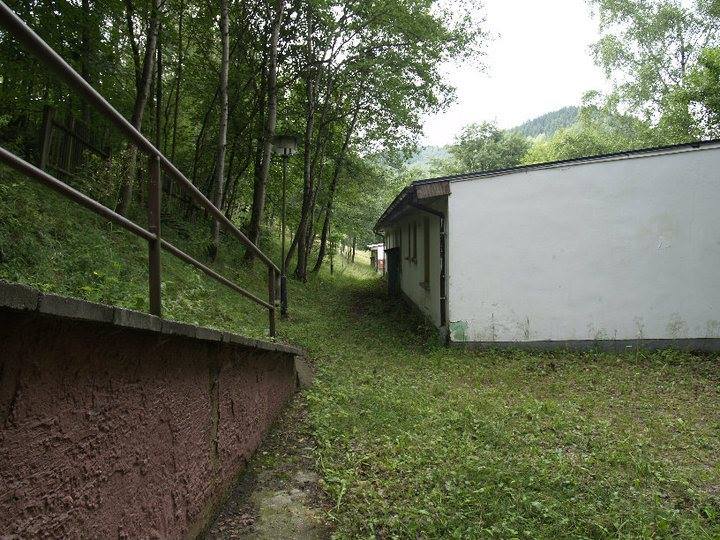
Dieses Bild hängt mit folgender Bildunterschrift im Refugees Emancipation Community Center:
As in Kunersdorf, people in Hohenleipisch live in old isolated buildings in the middle of nowhere. Can you imagine coming home to those conditions every day?
Wie in Kunersdorf leben die Menschen in Hohenleipisch in alten, abgeschiedenen Gebäuden mitten im Nirgendwo. Können Sie sich vorstellen, jeden Tag unter diesen. Bedingungen nach Hause zu kommen?
Folge 3: Pyschosocial Isolation
Transkript des Audios
Podcast-Script: Isolated– Isolationserfahrungen von Geflüchteten in Brandenburger Unterkünften Ein Podcast von und mit Paula Küntzel und Jakob Tuchelt
Folge 3
Teaser:
[Fiona]: “i’ve always said this and i will keep saying it until heims are abolished the heim is a trap and not just a physical trap it’s an emotional and psychological trap”
[Ana]: Yeah, and you don’t have a working permit, you don’t have anything, plus, you can’t work if you’re, another thing, you can’t, you’re not allowed to work if you’re in the first reception center.
[Theo]: “Many nightclubs, when you come, you are a black man, it is not easy for you. Once I tried to go to see the atmosphere, but I didn’t receive a good appreciation. (..) So I don’t go anywhere now.”
[Ana]: “So, what makes us, makes us different? So, you’re just like, ah, maybe it’s because we are blacks and they are white. […] So, I mean, that, you just feel, maybe, racism or, or, uh, she’s just, uh, I don’t know how to put it, but, if, for lack of a better word, racism at its peak.”
[Fiona]: “so there’s that dependency which is actually very unhealthy because you stop you stop having dreams and self determination […] you become dependent so exactly what a lot of refugees are running away from their homes that dependency of aid and just you know that saviorism you come and replicate it her”
Introduction
[Jakob] Welcome back to episode 3 of our Podcast Isolated- a Podcast about isolation experiences of refugees in Brandenburg. I’m Jakob.
[Paula:] And I am Paula, and we study sociology at the university of Potsdam.. Looking Back into the last Episode:
[Jakob] In our last episode we talked about our trip to a refugee shelter and about physical isolation.
Today, in the third episode, we will deal with the topic of psychosocial isolation.
[Paula]: All people we interviewed for this podcast on their personal experiences were anonimized by us and are being reffered to under a fake name.
[Jakob]: We have to adress that both Paula and me are white and, like our parents, were born and raised in Germany. Accordingly, we have never had to experience racism restricting our lives or our everyday routines in any way.
Topic of this Episode
[Paula]: As already said, In this episode we will talk about psychosocial isolation. But what do we mean by psychosocial isolation? [Fiona] explains this from her professional point of view.
[Fiona]: And then there’s a psychosocial aspect of it that, first of all, the neighbourhood and the towns where these Wohnheims are, (.) there’s a feeling that they’re over there, they’re hidden, that place far, because they’re dangerous. (..) or they’re not ready to integrate or you are not supposed to integrate with them or even socialize with them. So there’s that mental block. Then there’s also the feeling that normal things, determinations and dreams and hopes for human life, you know, that you want your children to go to good schools or to be in good neighbourhoods, safe neighbourhoods, that you determine what kind of life you want to live. But all this has been taken away. You sort of like just have to take it without questioning. (.) So why I call it psychosocial is because it’s already been put in your mind that you have no choice. (..) You just take what we give you and be quiet and just do not complain. So you will see a lot of people who live in these kinds of accommodations sort of just go unnoticed. They don’t want to participate in community building, in political work. They’re basically non-existent. They’re faceless. They’re voiceless because of the isolation [Jakob]: As you can hear, there is a mental effect from the physical isolation, which we already adressed in our last episode. In this episode we will talk about the instance that psychosocial isolation works in two directions: On one hand, the german civil society is mentally isolated from the refugees, because of spatial isolation of refugee shelters, amongst other types of isolation. On the other hand, refugees are mentally and socially isolated from participating in society and prevented from building and keeping strong connections to each other.
[Paula]: In this episode our interviewees will tell us closer how they feel living in germany and in the refugee accomodation. They´ll talk about their everyday structure and experiences of racism, about their oppinion on working permits for refugees, live chances, health and mental health, lonelyness and relationships, their impressions of germany and german people, and about belonging. We have asked all interviewees what it generally fells like living in germany to them.
[Stephan]: “Bon, je veux d’abord dire une chose, c’est que je peux pas dire que je me sens mal, parce que quelque part l’Allemagne m’a accueilli et elle m’aide avec le social mais… bien vrai, moi je suis beaucoup triste en Allemagne parce que, je sais pas, euh…, la solitude c’est quoi, c’est que là où je vis dans mon Heim, là où je vis…”
[ENG]: Well, first I’d like to say one thing, and that’s that I can’t say I feel bad, because in a way Germany has taken me in and it is helping me with the social benefits but … it’s true, I am sad a lot in Germany because, I don’t know, uhh …, being alone, it’s, you know, it’s that where I am living, in my hostel, where I live …
[Ana]: “Well, living in Germany and Brandenburg as a refugee is not something very easy.It has a lot of challenges, especially being that you don’t understand the German language and maybe the culture. (.) It’s a little bit of a challenge there because most of the time, even when you want to just buy maybe something to eat, it’s a problem having to express yourself and all that. Plus, you always just feel like people look at you weirdly. So, like, someone, no one is really, really willing to listen to you, you know, and, plus, you can’t really express yourself well in the German language, so, you know, you don’t really have much of a bargaining chip.(…) So, yeah, everyday life in Germany? (..) No. (….) It has quite a bit of challenges, yeah.” [Paula]: The interviewees also tell us how they feel about living in the Heim. By Heim the refugee accommodation is meant.
[Stephan]: “Donc je veux juste dire en conclusion, on peut dire que… il faut voir que la majorité des Camerounais qui sont là-bas ne vivent pas dans le Sozialheim, parce que le Heim c’est ta maison. C’est quand tu es en Allemagne, quand tu es dans le Heim, le Heim c’est ta maison. Ça veut dire que tu n’as pas une autre maison en dehors du Heim, le Heim c’est ta maison. Alors tu ne peux pas être chez toi, tu es mal à l’aise. Il faut que tu viennes à Berlin pour te défouler un peu, pour aller voir les amis, ou bien peut-être aller dormir chez un de tes amis, parce que tu n’es pas à l’aise chez toi.“
[ENG]: So I’d just like to say, to conclude, one can say that … you have to see that most of the Cameroonians who are there don’t live in the heim, because – the heim is your home. It’s, when you’re in Germany, when you’re at the heim, the heim is your home. That means that you don’t have anywhere else to live apart from the heim, the heim is your home. So you can’t feel at home, you don’t feel comfortable. You have to come to Berlin to relax a bit, to visit friends, or perhaps to stay overnight with one of your friends, because you don’t feel comfortable when you’re at home.
[Jakob]: In housing studies, the question of what exactly constitutes a home is a much-discussed topic. A distinction is often made between concepts relating to space and those relating to place. Professor Hazel Easthope, University Sydney writes the following in a review article on different Theories about the topic : The Title of the article is ‘A Place called Home’:
„While homes may be located, it is not the location that is ‘home’. Instead, homes can be understood as ‘places’ that hold considerable social, psychological and emotive meaning for individuals and for groups […] home is “a key element in the development of people’s sense of themselves as belonging to a place A home therefore is much more than just a place. Based on this definition, it quickly becomes clear that refugee shelters are often not places that offer the opportunity to develop a sense of home. Fiona puts this in a bigger context and adds what in her view would be necessary to change that bearing down situation.
[Fiona]: “I’ve always said this and i will keep saying it until heims are abolished the heim is a trap and not just a physical trap it’s an emotional and psychological trap yeah because to it’s putting humans in uh confinement and and putting them in situations where so much is isolated or removed or they’re they’re there’s so much distance between them and making their lives better or uh determining for self what where which direction their lives will take so it’s almost like when you come to a heim they take away the hope they take away faith they take away beliefs they take away you know possibilities to just determine for yourself as a as a human being”
[Paula]: These issues, adressed by Fiona, we will explore further in this episode. Living in shared accommodation has a direct impact on how everyday life is structured. We remember, for example, curfews and other restrictions.
However, the feelings that arise are not only linked to the heim, but also affect the everyday life of refugees. Stephane shared his daily routine with us:
[Stephane]: “Et moi je vis vraiment du jour au jour là-bas parce que je ne me sens plus en sécurité tandis que je pars à l’école à 17h15, finis à 20h. Et quand je rentre, je dors. Or, ce qui n’est pas normal.”
[ENG]: And there I really live from one day to the next because I don’t feel safe anymore, whereas I leave for school at 5.15 p.m. and finish at 8 p.m. And when I get back, I sleep. The social worker doesn’t say hello. That’s not how it should be.
[Jakob]: As important caregivers, social workers play a central role in the accommodation centers! In our next Episode „Isolation of Information“ we´ll take a closer look on the key role of social workers.
[Paula]: Theodore also tells us about his living experience in Germany. For context, we have to add, that he wanted to start a german course but didnt get an answer on his application for one year. He will speak about „social“ and „ausländer“. By „social“ the social sevices are meant and by áusländer´ the immigration office, (which is „Ausländer-Behörde“ in german)
[Theo]: “In Germany, it’s busy. Before, when I explained to you, I was alone in my room because I didn’t start the course. Sometimes I felt stress. Sometimes I take a bus or train. I go to Berlin, I visit the city and I come back. Every time I have my phone, I call my family in my country, talk with them.
I have also one niece in Berlin, sometimes two or three months. I go to meet her. I spend one or two days with her and I come back.(..) Sometimes I receive a letter from a social or from an outlander. I go and I talk with them. I come back after I start the course. I have a course every day. My course starts Monday and finishes on Thursday. From 8 o’clock to 11 o’clock. I go from Monday to Thursday, I go to school. (..) When I come back, I start my course. Sometimes, if I feel I was tired, I see the film on my computer. I sleep. (…) This is the same thing every day41-. | After I meet Mr. Cho, because in my country, I lead an organization. I’m the president of my organization.”
[Paula]: Except for that, Theodore does voluntary work, once a week.
Stephan continues to tell us about his everyday live.
[Stephan]:Je suis obligé toujours de venir à Berlin, parce qu’on se sent frustré, et c’est un peu ça que moi je vis, mais sinon à ce niveau, moi je ne me plains pas, parce qu’en Europe chacun fait sa vie, chacun fait ce qu’il veut, donc tu n’as pas le droit de regarder ce que l’autre fait, ou bien ce que tel fait, donc, à ce niveau, moi je n’ai pas de problème, parce que moi je sors, je suis d’abord chez moi, je sors, je vais à l’école, quand j’ai fini l’école, comme j’ai dit c’est vendredi, j’ai fini l’école, j’ai fini l’école, je vais aller à la vie, bon, après ça je rentre chez moi et je pars dormir, donc en un seul mot pour dire c’est que quand je suis chez moi, je suis chez moi, quand je sors, je ne veux pas les contacts avec les gens, et puis en dehors du petit avec qui je cause bien mes anciennes relations, (unverständlich, vielleicht „comme tel était“) Eisen[hüttenstadt] ou bin (unverständlich), je vais chez la Camerounaise(das ist wohl eine von einer Kamerunerin betriebene Kneipe), boire souvent, je bois ma bière, je rentre chez moi. [ENG]: I always have to come to Berlin because you feel frustrated and that’s a bit what I’m going through, but otherwise on that level, I’m not complaining because in Europe everybody makes their own life, everybody does what they want, so you don’t have the right to look at what other people are doing, or what a particular person is doing, on that level I don’t have a problem because I go out. First I’m at my place, I go out, I go to school, when I’ve finished school, like I said, it’s Friday, I’ve finished school, I’ve finished school, I’m going to start living, okay. After that I go home and I go to bed. But in a nutshell it’s: when I’m at home, I’m at home, and when I go out I don’t want to meet with people, and then, apart from the boy I talk to, okay, the people I used to hang out with, like in Eisen[hüttenstadt], I go to the Cameroonian bar for a drink, often, I drink my beer, I go home again.
[Jakob]: According to figures from the Research Report 50 of the SOEP refugee Survey which [Ana]lyses data from 2017 to 2021, 20% of refugees often or very often felt socially isolated, compared to only around 6% of people without a migration background.
Social isolation in this case is understood as a combination of a lack of contact and a lack of relationships: refugees are more affected by a lack of relationships than other population groups. 14.2% of refugees have no close contact person.
Contact with Germans is particularly lacking among refugees living in shared accommodation. A fact that underscores [Fiona]s statement of double isolation, i.e. the isolation of refugees from Germans and vice versa.
All interviewees also tell us of experiences of racism that they have made in different areas of their everyday live. Some of them on a regular basis.
[Ana]: “another thing in school, because now that, that is where I’m, I interact with, maybe most, mostly other people from other countries, and, uh, for example, in my school, my teacher is Ukrainian, and, uh, in my class we, uh, three blacks. (.) I’m the only black lady and, uh, two other boys. (..) The way, and then most of my classmates are Ukrainians. Yeah. So most of the time they talk in Ukraine with the teacher. Mm-hmm. Uh, uh, sometimes when, uh, I feel like this is not something I’m making up, it’s something that has happened. The, the, one boy, one black boy was sick one day. He wasn’t really feeling so well in class and he wanted to go home. And he asked the teacher if he can go. And the teacher was like, no, no, you know, you have to, if you have, if you must go then you have to go and report to the office and all that. And this boy was really feeling bad. Mm-hmm. So, then the boy left him to go and talk to the people at the office and I think he didn’t find anyone. So he came back and he was like, just let me go. No, I can’t, you know, you have to inform the, the office that you’re.(.) Then, this happened also with one Ukrainian boy. Um, she left the class and went with the boy to the office to try and tell, because this, this Ukrainian boy also doesn’t speak good German. (.)Mm-hmm. Um, two, just to explain what’s up with the boy. (.) Mm-hmm. (.) To the, to the office guys. And then he came back. He even helped him to put his things in the bag and left the class. So, you know.”
[Jakob]: We were also told about experiences of racism during freetime activities. Theodore tells us that black people are usually not allowed into nightclubs.
[Theo]: “So when we come to the weekend, they accepted many people, but when we come, they told us that it is a private reception or something. (.) I asked my friend, I have one friend from Chad, I asked him, he told me here there are one or two, only one or two nightclubs who accepted black men. (.)
[00:15:55] Many nightclubs, when you come, you are a black man, it is not easy for you. Once I tried to go to see the atmosphere, but I didn’t receive a good appreciation. (..) So I don’t go anywhere now. When I go to school, I come back. Sometimes if I want, I go just to visit the city, I walk, I see the buildings, I see the place, the park, and I come back.” [Paula]: Lets bring in a little Data, to back things up:
Every two years, the German Center for Integration and Migration Research (DeZim) publishes the National Discrimination and Racism Monitoring Report.
This is a survey of over 9,500 people who, among other things, provide information about their personal experiences of discrimination. However, we must emphasise that this data does not explicitly refer to refugees!
Nevertheless, the majority of the characteristics relevant to the report also apply to refugees! A distinction is made between subtle discrimination (e.g. unfriendly behavior, being stared at, or not being taken seriously) and openly offensive discrimination (e.g. insults, harassment, threats, or physical attacks).
54%, or one in two, of the respondents who identified themselves as racially marked stated that they experienced discrimination at least once a month. In particular, Muslim (61%) and Black women (63%) as well as Black men (62%) experience increased subtle forms of discrimination.
These experiences are very real personal experiences that determine the everyday life and future of those affected! Ana shares with us a very specific situation and an attempt to find a way to deal with it. At the beginning, she refers to how the teacher in her language course treats students differently.
[Ana]: “So, what makes us, makes us different? So, you’re just like, ah, maybe it’s because we are blacks and they are white. Mm-hmm. (..) So, and it doesn’t, she doesn’t just do that to the Ukrainians because she’s Ukrainian, even the other white people, the Arabs and all that. She treats them, she treats them differently from the way she treats us. (.) So, I mean, that, you just feel, maybe, racism or, or, uh, she’s just, uh, I don’t know how to put it, but, if, for lack of a better word, racism at its peak. (…) Yeah. (…) So, that is how isolated we feel. (.) Or, sometimes when you go even to the supermarket, you, you want to ask for help on, like, one time I’m, I didn’t know how to use the bread cutter at the supermarket. Mm-hmm. And I wanted to buy bread, then I called the attendant. One attendant actually ignored me, like, literally just ignored me. Mm-hmm. (…) So, then, uh, so, I just stood there and I’m like, okay, I really need this bread. Well, I can’t carry it like that without, because it’s, I just didn’t know how to use the machine. Which is not a crime. No. No. (..) So, the attendant ignored me then, one, one attendant then came across and, you see, you see, the way you’d approach someone and say hi, you say hi to someone and they don’t respond to you. Mm-hmm. Wow. (…) And, she just told me, what do you want? Mm-hmm. And I told her, I, I need your help with, I want to buy bread and I need your help with the slicer, can you help me? And she didn’t talk, she just came and pressed those things and, she asked me, which bread doyou want? Then I gave her the bread. And she just put it there and she told me, if it’s done, this is what you do and get it off, okay. (…) Mm-hmm.(…) So, you see, the, like, those are, uh, just a little, some of the challenges we go through. And, I mean, as a person you really feel, I mean, there’s a, there’s just a certain way you feel about it.Mm-hmm. And, really, it makes you feel so, so bad about yourself. Because, what do you mean, you’re, I’m, I’m saying hi to you, it’s, it’s, it’s, it’s, a harmless hi. I mean, you just find a way to live with it now that you’re in the white man’s land, you just find a way to live with it. Most of the time, like, me personally, I would say, I really don’t let these things really get into me that much, but, you see, when it happens, when it happens firsthand, there’s a way, definitely, you’ll feel about it. But, for you to have a peaceful life here, you really have to just find a way to cope.”
[Jakob]: The experiences continue, Theodore tells us of his search for a flat.
[Theo]: “I don’t like my situation. (..)For this reason, I prefer to get an apartment. (.) Now I get money from here, for my social benefits. I can pay for the apartment if it’s not expensive. (.) I asked my niece if she could take the apartment with her name, and I would pay her. (..) She agreed. When she started the process, she spoke Deutsch normally, very well. (.) She started to call the woman, she talked with her. At the beginning, she thought that my niece was a Deutsch. She was friendly with her. But after she asked her what her country was, my niece told her that she was from Chad. (..) She changed her mind. She said that the apartment was not free for her only. There were many other people who applied for that. (…) She wanted to meet her and talk with her during her interview. (.) It was a long process, after she refused to give us the apartment. (..) I explained her situation to one guy from my IM. (..) He told me that this situation was not the first. (…) He had applied for an apartment before. But when a black guy applies for an apartment, he comes with his documents. He will call you if he gets the new apartment. There were no free apartments. But if he gets the new apartment, or if someone leaves his apartment, he will call you. You don’t receive a call from them. (.) But if it is a Ukrainian or Arab guy, you can get an apartment easily. (..) He gives them the documents before. After him, many people from Syria and Ukraine come and get apartments. When he comes back to ask them what the problem is, he says that he has applied here for a long time. But many people after me get apartments and don’t call me. They say that it is not a problem, they don’t get free apartments, you can wait. (…..) This is another reality for us. To get an apartment here is not easy. (…..)”
[Jakob]: Stephan tells us about a young man and how he was denied an important document
[Stephan]: „J’ai même une petite anecdote, pour dire vrai. Il y a un petit là-bas qu’on appelle Grisse, un jour il est venu pour demander son papier du social. La maman lui a dit que non, elle ne lui donne pas le papier du social. Il a dit qu’il partait à la police. C’est quand il est sorti pour aller à la police que la maman a senti que la police pouvait venir demander, l’interpeller, „pourquoi tu n’as pas voulu?“. Parce que c’est notre droit. On n’est pas arrivé là par hasard. Ça veut dire que si on est arrivé là, il y a un budget pour ça, pour nous gérer. Et maintenant quand tu sens que ton droit, tu ne peux pas avoir ton droit. Moi j’estime qu’elle était obligée de rappeler le gars. Le gars est revenu, elle a dit que non, attends, je vais te donner le Termin. Donc, je ne sais pas…”
[ENG]: I even have a little anecdote, to be honest. There is a boy there that people call Grisse. One day he came to get his paper from the social welfare office. The woman told him no, she wouldn’t give him the social welfare paper. He said he would go to the police. It was when he went out to go to the police that the woman realised that the police could come and ask, question her, «Why did you refuse?». Because it’s our right. It’s not by chance that we are here. That means that if you have arrived here, there’s a budget for that, to m[Ana]ge us. And now when you feel that your right, that you can’t get your right. In my view she was obliged to ask the guy to come back. The guy came back, she said no, wait, I’ll give you an appointment. So, I don’t know …
[Jakob]: All these experiences of everyday racism shape the reality of life for refugees. Later on, we will talk about the impact this can have on mental health. But first, let’s look at a specific issue that is often raised as an accusation:
Refugees are often accused of not working. Fiona links the feeling of living in a heim, the impact of racism and the connection to jobs and training places.
[Fiona]: “already you can see the breakdown of their self-confidence starts from the heim. Yeah. So you can imagine with what is going on with the racism and the escalation of racism in Brandenburg. If things are like this right where you live, how much more worse does it get outside the heim? Yeah. It can only get worse. Yes. And then the other impression I had that made me a little bit worried is this access to German courses and to services like to find information where to get Ausbildungsplätze, Job opportunity, medical intervention. They have no access, they don’t know where to start. And you can see a lot of them sit and almost like they are left with no choice but to sit back.”
[Paula]: We will speak about the access to information in more depth in the next episode. Where does this accusation that refugees don´t want to work come from? To understand this, let us take a look at the legal situation.
Working conditions inside the camps are ruled by the „Asylumseekers benefits act“, a law which by the way is only accessible in german language, which is why we had to translate it by ourselves. On a Sidenote: The Case that important documents such as ruling law etc. are not accessible in langauages spoken by refugees is something that occured plenty of times during our research.
Paragraph 5 of said act deals with working opportunities. Refugees who are able to work, are not employed, receive social funding and are no longer of school age may be required under this paragraph to perform minor tasks in their accommodation shelters or in the commune. [Jakob]: For these activities, they receive a statutory expense allowance of 80 cents per hour. The number of workinghours is 4 hours per day. If they refuse to perform a assigned activity, this is punishable with cuts in social funding. This paragraph, and especially the latest change in february of 2024, requiring refugees to perform community service such as raking leaves, is the subject of debate. Refugee councils and social workers are particularly critical of the fact that this law pretty much forces refugees to carry out work assigned to them. Since they are being left with no choice but to perform the tasks, in order to avoid punishment.
[Paula]: A very recently published study at the IAB, which is the Research Institute of the Federal Employement Agency, finds, that in fact the majority of refugees who came to Germany in 2015 are by now under employement. In Brandenburg 49% of the refugees who arrived in 2015 work currently.
At the same time it is important to understand that most refugees are subject to a general ban on regular employment, a topic which we will come back to in a moment! Many refugees who want to do regular work, very often fail to do so due to legal barriers.
[Ana]: “Yeah, and you don’t have a working permit, you don’t have anything, plus, you can’t work if you’re, another thing, you can’t, you’re not allowed to work if you’re in the first reception center.Mm-hmm. I think, maybe, they can just give work permits for people who would like to work. People who would, uh, like to go outside and work.Mm-hmm. They should just allow, give work permits.
Yeah, sometime, maybe they can just allow people to do these small jobs also at the camps. Yes, that is there, but, um, I understand some people don’t want to work and all that,but, yeah, they should give more of those, uh, small jobs. The cleaning jobs. The, yeah, most of the times it’s the cleaning jobs. Yeah. That’s what they are doing, but, I don’t know, maybe they could do it in, um, I don’t know(…) how to put it. (…….) Maybe pay a little bit more.“
[Jakob]: Now it gets a little more complicated, because we are dealing with the legal framework for work permits in general:
[Paula]: Asylum seekers who have received a positive decision on their asylum application from the Federal Office for Migration and Refugees are allowed to work in Germany without restriction. The same conditions apply to them as to Germans. Companies do not have to observe any special requirements when hiring asylum seekers.
In 2024 13.2% of the made Decisions on applications for asylum permitted a right to asylum. In February 2025 a decision on asylum took 12.3 months on average.
[Jakob]: Asylum seekers whose asylum proceedings have not yet been completed and those who have been granted temporary residence permit, are not allowed to work at all during the first three months of their stay in Germany. During this period, they are subject to an employment ban. After that, asylum seekers and tolerated persons generally have subordinate access to the labour market. To obtain specific employment, they must apply for a permit from the local immigration authority, which in turn must request approval from the Federal Employment Agency.
[Paula]: There are two criteria for approval by the Federal Employment Agency: the labour market test and the priority test.
The priority test clarifies whether the specific position can also be filled by Germans or foreigners who are registered as looking for a job, and have an unlimited working permit. The priority test is no longer required after 15 months of residence in Germany, afterwards tolerated persons generally have the same access to the labour market as asylum seekers.
[Jakob]: However, tolerated persons may be subject to an employment ban. During apprenticeship, tolerated persons have a guaranteed right of residence.
[Paula]: The minimum wage applies to refugees with unrestricted working permits, we remember: this means that their appliation on asylum has been accepted. Refugees without a working permit, meaning their application is still being processed or they have a temporary residence permit, can be employed under the circumstances we discussed earlier: Meaning 80 cents per hour and a punishment if they refuse the task!
[Jakob]: Since asylum applications often take much longer than a year to process, and only a fraction of applications are actually approved (in 2024, the figure was 13%), for the vast majority of refugees there are way more obstacles to get a job than for germans.
But it is not only legal hurdles that stand between refugees and employment: Fiona explains to us what aspects of mental blockage there are that make it so difficult to get a job.
[Fiona]: “Oh, if you’re that isolated from basic necessities and of course the physical block from not just yourself to Germans, but Germans to you, who’s going to give you a job? (.) Even the confidence to say, hey, I may look different, I sound different, I don’t speak the language, I’m new in this country. Okay, I’m going to go and search for a job and do an interview. You need to be a very crazy person to overcome all those blocks.”
[Paula]: The risk of social isolation decreases significantly as a result of starting employment or education. Figures from the Research Report 50, show a corresponding reduction of about 4 percentage points in the risk of lack of contact in general, and about 17 percentage points in the risk of lack of contact with Germans. In addition, data shows a direct correlation between the improvement of German language skills and participation in the labor market. Participation in employment and education is therefore one of the most important factors that can counteract social isolation and loneliness among refugees. Unfortunately, the widespread opposite leads to a long period of stagnation.
[Ana]: „I would really wish for so many things. But, I mean, you see, uh, for example, at the first reception centers, I would really wish that, um, they don’t, uh, keep people for so long at the first reception centers. (.)Mm-hmm. (.) Or maybe just, uh, try and, uh, let these people do something. If it’s language classes. Mm-hmm. Do, do, do really well structured language classes.Mm-hmm. Uh, to an extent of maybe doing the exams for maybe A, the A, A1 and A2 levels. Because you’ll find, like, someone like me, I stayed in the camp for 14 months. Mm-hmm. And in these 14 months, there was really nothing much going on.(..) And then people are not being productive there. So why do you want to keep, like, how many, over a hundred people in one place? And they are not really being productive in any way.”
[Jakob]: Ana tells us, that she was able to join a german class aswell as a german learning group later, which was really helpful for her. We talked About the first reception centers and in more detail the duration of stays in the refugee camps the last episode.
A bit earlier in this episode Theodore told us how he spend most of his time in his room for a year because he couldnt take a german course. He tells us in more detail how that happened:
[Theo]: “I asked to study the language course, the language Deutsch. When I, my first situation, when I came in the school, I asked them if I can apply for school. (.) They accepted. They gave me the formula. I filled the formula and they told me I must wait maybe two or three weeks after. If I don’t give them the answer and the answer is positive, they will call me and I could start the course. (..) Unfortunately, they called me six months later. When I come, they gave me the little text. They told me they want to see my level in Deutsch. (.) So I made the test. They told me they will call me one or two weeks later. I accepted to come back. So I waited the call. I didn’t receive anything during one year. (.) One year after, our official in the social told me I must go and ask them what matters. (..) So when I asked them, they told me no, the program, I must start the course in February. So I lost one year. (..) I didn’t do anything. I was alone in my room. I saw many people who came after me, started the course before me. This is my first situation. I started the course. I lost one year. I will finish my B1 in February here.”
[Paula]: This kind of severe setback often affects people with ambitions, as was the case with Theodore:
[Theo]: “For me, for example, in my country I have good condition. I don’t leave my country because I want to stay in Europe. (…) I have my diploma, I work, I am a teacher, I come to the university as an assistant. In high school I teach physics. (.) I have an organization, I have my farm. (….) [00:30:48] I have a situation. (.) But I explain them with all proof that I received from our government. (……) I don’t want to be persecuted. (….) Nobody takes the time to see my situation. I come just to share the good condition.”
[Paula]: The recognition of educational qualifications runs separate from the asylum procedure. A residence permit is not necessary, and nationality is formally irrelevant. Each educational qualification is examined and compared individually and either recognized or rejected. The procedure usually takes 3 to 4 months, assuming all documents are complete. The costs of the procedure must be borne by the applicant. All documents must be submitted in copy form and with a German translation. Perhaps it is worth emphasizing that because refugees are part of the normal recognition procedure, the recognition of qualifications is enormously difficult for them.
[Jakob]: Many of the documents that need to be submitted, such as school certificates, are not among the items that were taken with them when they fled. Especially the fact that all documents must be submitted in German complicates the procedure, as people without income cannot afford professional translators. But it is not only in the labour market and in government agencies that refugees face additional hurdles. Refugee women are particularly hard hit. They are often structurally forgotten or excluded. Says Fiona [Fiona]: “it’s normal everyday small things that you have to just do a little bit extra for the women to accommodate them (…)and (…) the problem is we don’t look at this problem long term because if women are suffering imagine the quality of children they’re raising(..) it (..)means they’re raising children who are also going to be limited like them (.)and (.) that is why you see a lot of refugee children who have capacities and they have the (.) talent and the brains to go to studium and (.) go into very good fields of study but no all of them are pushed to Ausbildung and flag and you know (..)it’s (..) not (..) sustainable and it’s not right”
[Jakob]: Fiona goes on to explain the role that trauma and socialisation play for refugee women:
[Fiona]: „a woman (..) it’s going to be difficult especially with children (..) so (..) there’s (…) an element of just (..) physical ability let’s start from there (…) then there’s also the element of (..) women (..) tend to be to (..) shy of confrontation and things where they have to force their way (..) and (..) a lot of these things you have to fight for (..) women just don’t have it in them (..) and (..) then there’s the mental (…) understanding that women are supposed to be docile and calm and so you do not want to cause any problems by complaining and you know asking and demanding and (..) then of course don’t forget these people are coming from places where there’s trauma and they’re coming from things that are already difficult so (.) we (..) cannot expect them to function at 100 there’s (……) cultural differences they’re not women are refugee women especially are not socialized like German women to (….) say (….) that they don’t feel like oh some of them come from places where women don’t really go to school or if they do you have to be uber talented you must be that one special girl then you are allowed to go to school (.) so (.) for them to come here and see German boys and girls all going to school the same and it’s a shock it’s cultural shock (.) it’s (.) something a new concept so (…) there’s all this learning and all these things to get over while in this asylum system which is traumatizing in itself already so it’s it’s a little bit harder for women than it is for men (..) all while raising children and being caregivers not to only themselves but almost everyone around” [Jakob]: According to Fiona, caring for everyone around them also includes a special relationship with social workers. However, this makes refugee women dependent on their environment:
[Fiona]: “so there’s that dependency which is actually very unhealthy because you stop you stop having dreams and self determination and you know just proper self management skills and you become dependent so exactly what a lot of refugees are running away from their homes that dependency of aid and just you know that saviorism you come and replicate it here (..) it starts all over again start looking at (.) normal German people as your saviors when the truth is they are not (..) they are (..) not they probably are suffering just differently and they only have capacities for their own lives “
[Paula]: So far We have heard that psychosocial isolation in shelters leads, among other things, to a state of inaction, but the paths out of this situation, such as finding a job, are fraught with enormous barriers. The paths are further blocked by a mental barrier, as experiences of everyday racism and other forms of discrimination create a hostile surrounding.
All these things can lead to massive mental stress and health problems like depression. [Fiona]: “So that’s why you see things like depression, people going crazy, people turning into alcoholics, people turning into drug use, you know, just idleness, just sitting there with nothing, no stimuli,nothing to stimulate your mind. It puts you under a state of, I don’t know, self-destruction.It’s human nature, but it’s really interesting to have experienced a lot of people I lived with and I see them today and they are not who I met in the beginning. They have completely changed. Maybe alcoholism, the drug use, this hopelessness, you know, no sense of direction, no sense of decision-making for your life, no self-determination. It’s just not there. There’s no possibility. So for me, it feels like a death sentence. It’s living just waiting for the day you die for it to end because there’s no other solution. While you’re there, you cannot know there’s any other solution unless now then you’re people like me who believe in alternatives, like something has got to work, that you go out, which takes a lot of physical energy, a lot of self-confidence, a lot of just self-belief to overcome what is your environment and go out and find right information. Only a few people can do that, not everybody. So it is a death sentence. It really is a death sentence.”
[Jakob]: So, according to Fiona structures in germany, that have an impact on refugees, actively lead refugees into desparation and hopelessness. in public opinion, refugees are often viewed as already arriving in germany in a state of distress. However, there is rarely a focus on the impact of the german asylum system and living in germany as a refugee on the mental heath of refugees.
[Paula]: The DeZim Discrimination Report makes the following diagnosis regarding the connection between mental health and discrimination:
„Discrimination is associated with an increased risk of psychological distress. People who experience discrimination several times a month show significantly higher levels of depressive symptoms and anxiety disorders than people who do not have such experiences. Muslim and Asian people are particularly affected: on third of those who frequently experience discrimination report moderate or severe symptoms – compared to around 10% of those who do not experience discrimination.“ [Jakob]: We can therefore conclude that the (mental) health of refugees in Germany is closely linked to experiences of discrimination. However, refugees face further obstacles in accessing healthcare:
The Barier refugees are facing when it comes to access to healthcare is first and foremost a legal barrier. Within the first 3 years of stay refugees are only allowed access to healtcare if they have a severe medical problem or pain. In many federal states, treatment must first be approved by the responsible social office, often by employees who have no medical training.
The Psychosocial Care Report published by the nationwide Working Group of Psychosocial Centers for Refugees and Victims of Torture, identifies a gap in care for refugees. This gap exists not only due to legal barriers, but is also related to inadequate resources and knowledge within the healthcare system. [Paula]: Ana gives us a an insight into the health situation in the shelters.
[Paula]: “Um, one question, one more question about, uh, Eisen. Is it, is there any medical or, um, psychological, um, help there for people?”
[Ana]: “Yeah, there is.But what I experienced, yeah, there’s this, there’s a psychologist. Yeah. [10 second pause] Mm-hmm.If you get sick at night, You can, if it’s something serious, you can easily just die. (.)
There’s one time my roommate, she had ulcers. (..) And her ulcers, I think, were so advanced. This girl used to cry at night. Yeah. She’s feeling pain. (..) Mm-hmm. (..) So there’s this one time I took her, I told her, let’s go and ask the security guys if they can take you to the hospital. Mm-hmm. And she didn’t even want to go, she told me, I, I had already gone to the hospital, these guys didn’t help me much. And that very day that she was really hurting, she had been to the doctor, to the camp doctor. And the doctor just gave her some medication, which were not helping her, because she had been in this medication for so long, they were not really helping her. Mm-hmm. And she had also requested the doctor for a referral, maybe to go now to a proper hospital. The doctor said, no, why do you want to go to the hospital? This is not something serious and all that. So I think, like, they don’t really care much about when you’re sick or you have these conditions, (.) because that is from my own experience with my roommate and her ulcers. So this particular day when we went to the security guys, they took her to the hospital, and I don’t even know what happened to that hospital. She was given, I don’t know, she was just given tablets. She wasn’t even examined. Mm-hmm. Like, nothing. Mm-hmm. And you know the ulcers, they get to a certain point, they’re really, really hurting. (.) And there’s a way you need to be examined for them to tell what stage you are. Well, sometimes you go and they tell you that, you know, we cannot treat you here. You just wait until you get your transfer so that you go to a proper hospital. Mm-hmm. So how long are you going to wait? You are in the camp for 14 months. You’re sickling and they’re telling you, you should wait for when you get a transfer to go to a proper hospital outside when you go to a heim. Mm-hmm. (..) Yeah. (..) So, yeah, that is also something maybe, something notable, maybe it should be addressed. And that was happening to a lot of people. (.) Unless you are, I don’t know, I don’t know at what point they took people to the hospital. But when you are sick and you can maybe walk then, you’re not really sick.”
[Paula]: Fiona once again highlights the unique situation of refugee women
[Fiona]: “In Eisenhüttenstatt (..) women (..) who had their menstrual periods (.) because of how life is set up in the (.) reception center (.) you (.) almost have to function normally even if you have menstrual cramps remember it’s a new country so you’re probably experiencing winter for the first time so your body functions very differently but you must wake up and go like a normal person (…) so (…) for women especially a lot of things are an extra challenge so (.) it puts them more under pressure and the more under pressure the women are the more invisible they are you will not see them anywhere they (..) almost completely disappear off (.) and (.) if you do a survey it (.) is (.) women and children who live in the von heim the longest because (..) the (..) possibilities to move out are so difficult so so difficult so (…) what happens is they sit and wait there’s almost like a savior syndrome oh I must be good to the heim light then she can help me find an apartment or she can help find a place for my child in Kita.”
[Paula]: All interviewees tell us that they sometimes feel lonely or dont have anyone to talk to about their problems. acording to the FB50. This is the case for alarge proportion of refugees as 20% of Refugees stated that they feel social loneliness often or very often. At the same time only 5% of people with no migration backgorund felt the same way.
Maybe you remember how stephane said in the beginning of this episode that he often feels sad in Germany. William and Ana told us about something similar aswell.
[William]: “Oui, je me sens isolé, parce que parfois, quand j’ai un problème, et je ne trouve pas de solution, ça me fait stresser. (…)”
[Paula]: “So the people from your language course, do you have that feeling of belonging there sometimes?”
[William]: “Yes. À l’école, j’ai deux amis avec lesquels on dialogue. Mais on ne parle pas trop de choses personnelles, quoi. Il y a le quotidien, comment on vit ici, voilà, c’est tout.”
[ENG]:
[William]: “Yes, I feel isolated, because sometimes, when I have a problem, and I can’t find a solution, it stresses me out (…)”
[Paula]: “So the people from your language course, do you have that feeling of belonging there sometimes?”
[William]: ”Yes. At school I have two friends I talk to. But we don’t talk much about personal things. Everyday things, what our lives are like here, that’s all.”
[Ana]: “Very much isolated and lonely, yeah. (..)Why? Because, um, you would not really find anyone willing to talk to you, um, freely, uh, maybe sometimes you feel, maybe you’re lost or you wanted just to ask, I want to go to this place, which gleis should I take? Maybe the zoo or the bus, like, where do I get the bus? (…) And, you go and say hi to someone and they walk away through. Mm-hmm. (.) I mean, yeah, you really feel that”
[Jakob]: The FB50 shows that most refugees only have close contact to members of their own family, this applies to the case that family members are present in the first place.
However, it is difficult for refugees to maintain relationships with each other, especially across different accomodations, due to house and visitor regulations. Stephane shared a story with us
[Stephan]: “Et il y a même un jour où je suis venu avec elle, parce que ce jour-là on était un peu dans l’ambiance, on a bu peut-être jusqu’à 6h, on est arrivé vers les 6h, on m’a dit que non, elle ne peut pas entrer à 6h. J’ai demandé, comment, une femme qui vit à Berlin, elle arrive à 6h du matin, je crois que les visites commencent au matin jusqu’à 22h. On m’a dit qu’elle ne pouvait pas entrer. Je les ai suppliés, fatigués, elle est entrée.”
[ENG]: There was even one day when I went with her, because on that day we were a bit in a good mood, we had been drinking perhaps until 6 a.m., we arrived at about 6, and they said no, she can’t go in at 6. I asked, what, a woman who lives in Berlin, arrives at 6 in the morning, I think the visiting hours start in the morning and go on till 10 p.m. They told me that she could not go in.
[Paula]: The rules for visitors are part of the house rules. These vary depending on the home operator and home m[Ana]gement.
Strict visitor regulations are particularly problematic when they affect relationships that are very important to those involved. Stephane continues:
[Stephan]: “Sinon c’est la seule personne avec qui vraiment je me distrais, on téléphone, on cause de tout et de rien, on bavarde, ça me fait un peu oublier, tu vois un peu. Quand je viens à Berlin, comme elle n’est pas loin de Jungfernheide, je passe par mon train à Jungfernheide, on se trouve à la gare, je prends mon train à 21h, à 22h je suis à la maison, je fais quelque chose à manger et puis je dors.
On se trouve à la gare, on cause, bref parfois elle vient aussi chez moi, on reste ensemble, ça m’enlève un peu le stress, tu vois un peu, Bon, en dehors de ça, moi je n’ai pas un autre problème, sinon que… je vais dire une chose, c’est que même la fille que je suis avec là présentement, c’est une fille bien, parce que si c’était pas une fille bien, c’est que moi j’aurais déjà pris mon recul depuis, c’est la seule personne vraiment qui me… parce que moi je n’ai pas de femme au Cameroun.
Quand je suis arrivé en Europe, j’ai dit que tout ce qui est resté au Cameroun, c’est pour le Cameroun, si il faut faire ma vie, c’est en Europe.
Donc, c’est la seule personne qui me… qui me réconforte un peu, parce que quand je suis avec elle j’oublie un peu cet (unverständlich), tout et tout, bon. Même dans mes problèmes d’asile, là elle m’aide beaucoup, parce que donc elle a parlé, elle m’a dit que non, ça va aller, tout et tout donc, en dehors d’elle, vraiment, quand je ne suis pas avec elle soit je suis avec mes frères camerounais quelque part et ça va, c’est tout.”
[ENG]: Otherwise she’s the only person I really have fun with. We phone, we talk about everything and nothing, we chat, that makes me forget a bit, you know, a bit. When I come to Berlin, because she’s not far from Jungernheide, I take the train to Jungfernheide, we meet at the station, I get my train at 9 in the evening, at 10 I’m back home, I make something to eat and then I sleep.
We meet at the station, we chat, sometimes she comes to my place, too, we stay together, that takes the stress off me a bit, you know, a bit. So, apart from that I don’t have any other problems, except … I’m going to say something, and that’s that even the girl I’m with at the moment, she’s a good girl, because if she wasn’t a good girl, I would have stepped back since. She’s really the only person who … because I don’t have a wife in Cameroon. When I arrived in Europe I said that everything that has stayed behind in Cameroon is for Cameroon. If I have to make my life, it’s in Europe.
So she’s the only person who… who comforts me a bit, because when I’m with her I forget a bit this heim, and all that, okay. Even with my asylum problems she helps me a lot, because she talked, she said no, it’ll work out, and so on. So apart from her, really, when I’m not with her I am with my Cameroonian brothers somewhere and I’m okay, and that’s it.
[Jakob]: According to the FB50, Refugees are more affected by a lack of relationships than other population groups. 14.2% of refugees have no close relationship. Living together with a partner has a huge impact on wether refugees have close relationships outside of their families. Living together lowers the possibitly off interaction outside of the family by almost 15%. While refugee men often have no close confidants at all, refugee women comparatively rarely have close confidants outside of their family.
In the first episode we talked about not seeing any women in the heim, and speculated about the possible reasons. In the same context Fiona said the following:
[Fiona]: “about the concept of integration as as racist as it is already um you have to allow people to live in they’re not in a natural normal setting with everybody there men women children regardless of their religion their culture their whatever yeah normal simulate a normal society but if you share out refugees only men to a certain area that’s not a normal yeah that’s not integration so you’ve already set them back”
[Jakob]: In an individual interview, Fiona elaborated on this idea further.
[Fiona]: “in my experience when you put people under so much pressure relationships break and the way the (..) asylum system functions it treats people individually your (.) asylum case is never treated as a family (.) there’s no case file family so and so no no no it’s individuals in that family (…) that’s what comes and breaks those relationships and you see men moving away from their families women taking care of their children I mean even the (.) often told (..) mothers get it easier from their kids than men do (.) it’s so it’s things like this that finally determine if the family stays together (..) but it’s all based on the system it’s just too harsh too rough on the family dynamic (..) it’s too and (..) Germany as a society I have (.) come to accept that it’s a very individualistic society you always have to think about me me me me so there’s sort of like (..) it’s (..) very easy to sort of step away from your responsibilities as a man (…) because (…) you’ll (…) still survive maybe I mean there’s no social (….) there’s (.) no social like sort of like a punishment but not just punishment but there’s attachment to I must keep my family together no it’s not there the society thrives on individuality so you step away from your family as a mom the (.)job (.) center will take care of her take care of the child welfare she has all these things she can apply she doesn’t need a mom that’s what a lot of people think (…) while wherever they’re coming from most people stay together to manage the” resources to share what little they have but here when you go your separate ways you get more resources
[Paula]: At the beginning of the episode, we heard individual impressions of how our interviewees experience life in Germany. They also told us about the differences they see in the social structure between Germany and Europe and their home countries. Ana and Stephane give us an impression.
[Stephane]: “mais sinon à ce niveau, moi je ne me plains pas, parce qu’en Europe chacun fait sa vie, chacun fait ce qu’il veut, donc tu n’as pas le droit de regarder ce que l’autre fait”
[ENG]: but otherwise on that level, I’m not complaining because in Europe everybody makes their own life, everybody does what they want, so you don’t have the right to look at what other people are doing, or what a particular person is doing
[Ana]: “You see, for example, in my country, if you come to my country as a, as a foreigner, you, (.) you’ll feel so nice, people will treat you so nicely. No, no one would really make you feel like, oh, this is a country for black people, who see the way they’re looking at us and all that. But here you, there’s stars who look at you and you feel like, wow, am I a monkey or an animal or some, how do I look like, why are these people staring at me like this? Mm-hmm. (.) So, it is okay for you, one, two. Other differences that come to my mind? I mean, I would just say generally, people from my country are friendly to foreigners, even more than we are to each other. Mm-hmm. (..) And that is not, that’s not it here.”
[Jakob]: Earlier in this episode we talked about the aspects which constitute a home, according to Hazel Easthope. It was about feeling a sense of belonging to a place and helping to shape it. Fiona sums up this important connection again at the end of this episode and translates Theory into the reality of refugees.
[Fiona]: “I say that to mean the (.) feeling of not being in the right place you will never feel like you belong unless you decide that it’s your home your environment cannot decide for you it has to come from you. Why I say that why I made that statement here is to say (.) in (.) with the laws asylum laws in Germany the way they are it’s almost like the environment determines a home for you”
[Paula]: “how do people decide what their home is usually?”
[Fiona]: “when they are happy and they feel settled and they can easily reach out for their dreams you want to learn German you learn German it’s not a must no one is shouting down your face no one is threatening you (.) that’s not life it must come easy it must be a decision you know (….) the way (….) the society functions here it’s very unforgiving to foreigners it’s almost like yeah you moved that was the biggest mistake you made so because you moved you must do one two three German learn learn the laws do this do that almost like (..) do (..) much more than is required of even Germans who were born and brought up here so why must you qualify to (..) call Germany a home (.) why (.) must you qualify.”
[Paula]: We have reached the end of our episode on Psychosocial Isolation.
In our next an final Episode “Isolation of Information” we will look at refugees‘ access to important information. It will become clear that all previous types of isolation are linked to and reinforced by a lack of information.
Furthermore, it is not a one-sided isolation of information for refugees; conversely, the flow of information from the shelters to the outside world is also extremely slow.
[Jakob]: We hope you enjoyed this episode, and we’ll see you again in the next one!
[Paula] Bye for now!
Ending
[Ana]: “at the end of the day, I am me. I can’t be you. I am black. I cannot turn into white to please you. At the end of the day, I have my own personality. I have my own person. I am my own person. So, really, for me, I don’t, I don’t, um, really think so much about it. But, of course, when it happens, yes, there’s a way you feel. You can’t deny that.”
[William]: Je voudrais que les Allemands et les étrangers vivent comme des frères. (.) Et n’aient pas de haine. Peut-être pour quelque chose qui s’est passé il y a 100 siècles. (…..)
[ENG]: I want Germans and foreigners to live as brothers. (.) And not to hate each other. Perhaps for something that happened 100 centuries ago. (…..)
Acknowledgements
[Paula]: We would like to thank: Refugees Emancipation for their tremendous support of the project, the connections, and their work. Special thanks go to:
Fiona Kisoso, Immaculate Chienku, Louise Nzele, and Eben Chu
We also thank our interview partners: Ana, Stephane, Theodore, and William for their trust and cooperation!
Thanks to Tobi, Theo and Anna for the voice-over.
A big thank you to Yohane Nkuibo, Max Guggenheim and Deirde Winter for translating the French interviews.
For mixing and technical assistance, we thank Johannes Tuchelt
[Jakob]: Isolated is a podcast produced by Paula Küntzel and Jakob Tuchelt in cooperation with Refugees Emancipation, for the Department of Social Structure Analysis at the University of Potsdam.
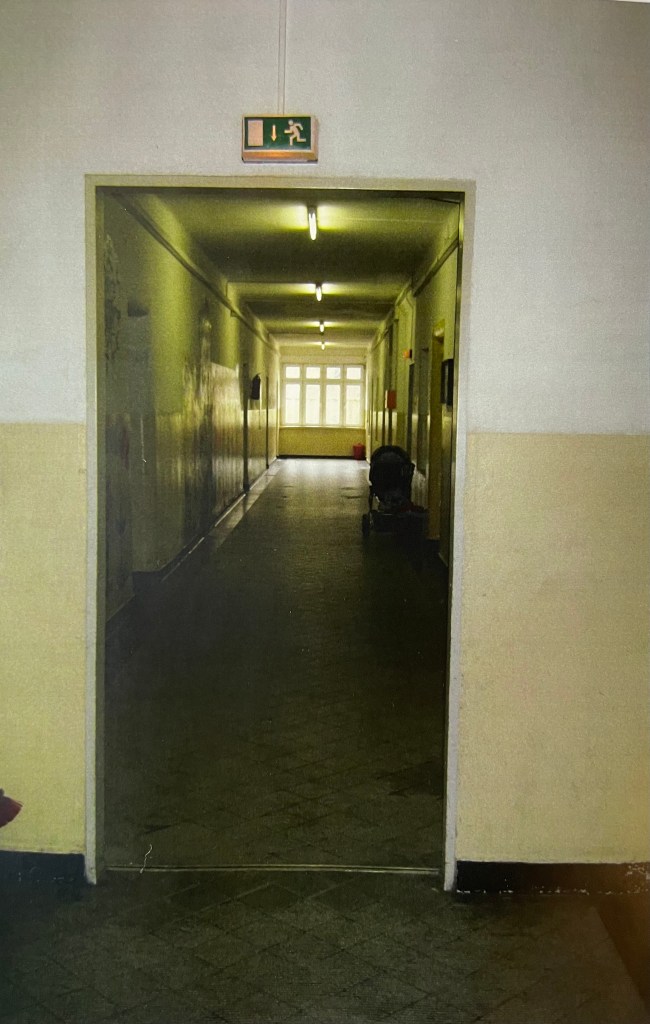
Dieses Bild hängt mit folgender Bildunterschrift im Refugees Emancipation Community Center:
Long corridors with no common areas where the only thing left to do is to isolate yourself in your room.
Lange Flure ohne Gemeinschaftsräume – das einzige, was bleibt, ist, sich in sein eigenes Zimmer zurückzuziehen.
Folge 4: Isolation from Information
Transkript des Audios
Podcast-Script: Isolated– Isolationserfahrungen von Geflüchteten in Brandenburger Unterkünften Ein Podcast von und mit Paula Küntzel und Jakob Tuchelt
Folge 4: Isolation of Information
Teaser:
[Fiona]: “you are really removed from information.[…] You’re sort of cut off from reality.”
[Theo]: “if you are lucky, you can meet a good person who can help you. Sometimes they don’t accept to talk with you. They say sometimes they are busy or they don’t have time to help you. You feel this isolation, this disappointment sometimes.” [Ana]: “So, this is the only contact person that you have, and if they are not helpful really, it makes your life so difficult.” Introduction [Jakob]: Welcome back to episode 4 of our Podcast Isolated- a Podcast about isolation experiences of refugees in Brandenburg. I’m Jakob. [Paula]: And I am Paula, and we study sociology at the university of Potsdam.. Looking Back into the last Episode: [Jakob] In the last three episodes we talked about our trip to a Refugee Camp and our impressions from that visit, about physical isolation and about psycho-social isolation. Today, in the fourth episode, we will take a look at isolation from information. [Paula]: All people we interviewed for this podcast on their personal experiences were anonimized by us and are being reffered to under a fake name. Topic of this Episode [Paula]: This episode deals with the topic Isolation from Information.There were many things the interviews had in common with one another. For example we noticed a shared lack of information. What is causing this lack is very restricted access for said Information. Information in this case could be something like: Where to get a language course, But also things which are very much important for the ongoing Application for asylum. [Jakob]: Fiona, from the NGO Refugees Emancipation, tells us that this type of isolation works in two directions: According to her, not only the refugees in the camps have a strongly restricted access to informaton but also the german civil society barely gets information on the insides of the camps and the lives of refugees. [Paula]: So, that means there is a barrier, which blocks contact and at the same time information in both directions. [Jakob]: According to the most recent ‘Research Report 50’ of the Socio Economic Panel a large proportion of refugees only rarely have contact with Germans. Depending on the duration of their stay, this applies to between 36% and 63% of female refugees and between 16% and 49% of male refugees during their first six years in Germany. That means, the majority of refugees have little or no contact with Germans. The barrier described by Fiona thus seems to actually exist. [Paula]:The isolation from information, our interviees experience, is visible in very specific situations. Something, all of them agreed on, was the importance of their social workers as most important source for information. Other topics in this episode will be the ongoing exchange with the Immigration office, lawyers, access to education and a general sparseness of information [Jakob]: In the last episode on psychoscoial isolation we already talked about lonelyness. In the begining of this episode [William] and [Theo]dore bring up the feeling of being left alone. They tell us about how hard it is to find help in such situations. [William]: “Oui, je me sens isolé, parce que parfois, quand j’ai un problème, et je ne trouve pas de solution, ça me fait stresser. (…)“ [ENG]: “Yes, I feel isolated, because sometimes, when I have a problem, and I can’t find a solution, it stresses me out (…)” [Theo]: “Like I said, everybody is busy here. It’s not easy to find someone to talk to every time. (.) Most of the time, I’m alone. When I go to school, I come back. I’m always alone. When I study or I see a film, I feel alone. Sometimes when you go on social, for example, to explain the situation, if you are lucky, you can meet a good person who can help you. Sometimes they don’t accept to talk with you. They say sometimes they are busy or they don’t have time to help you. You feel this isolation, this disappointment sometimes” [Paula]: How important the social worker as source for information is, is being empathized by Ana and Stephan. [Ana]: “I mean, she’s, you see, when you’re in this, you’re, when you’re in the camps, then your social worker is the contact person you have there, like, because you don’t know so much about where to go, what to do, and all that. So, this is the only contact person that you have, and if they are not helpful really, it makes your life so difficult. Mm-hmm. Because sometimes when you go and maybe you, you want an appointment, maybe at the ausländer, or, uh, you want, uh, with a hospital or something, if they can’t help you really, it will be really difficult for you to move forward with a lot of things. So, for me, for me, it’s a plus. I really like that. Also, the people I’m in, with, in my room, they’re all from my country. So, that also, I mean, you can talk, you can, yeah. Now, really relate, uh, so while at the camp, I really don’t feel so isolated.” Stephan: “concernant l’isolation moi je ne suis pas trop isolé parce que je suis isolé dans mon rêve [Heim] parce que le rêve [Heim] ne se passe pas comme ça c’est à dire que quand tu as ton [Heim] si tu n’es pas en harmonie avec ton social tu ne vis pas tu es diminué, ça pour dire vrai “ [ENG]: as far as isolation is concerned, I’m not too isolated, except in my asylum home, because life in a home isn’t normally like that; in other words, when in your home, you’re not in harmony with the social office, you don’t live, you’re diminished, that’s the truth. [Jakob]: It shows that the social workers are very important to find Orientation in a foreign country. For refugees they are one of the very few gateways to information from the outside. How few of these information gateways there are, is also beeing described by Fiona: [Fiona]: “Because if there’s sort of something going on in Germany, they’re usually the last people to know. I would know this because when I lived in the Wohenheim, I think I realized about COVID so late. And it was something, it was big news. It was world news. But I had no way. We didn’t have internet. We didn’t have, you know, we don’t have TV. We don’t have all that in the Wohenheim. So the world is moving on and you’re left behind.” [Paula]: Lets do a quick fact check: The study we already reffered to, i.e. the ‘Research Report 50’ of the SOEP refugee survey, published in November last year, deals quite explicitly with experiences of isolation. The study Analyses data from 2016-2022 and comes to a number of conclusions. Including this one: Particularly high proportions with only infrequent or no contact with Germans can be seen in the early phase after arrival in Germany and during the COVID pandemic. The frequency of contact with Germans increases with the length of stay in Germany. [Jakob]: The results of another study, carried out at the Psychosocial Counselling Centre for Refugees (PBF) at the Centre for Psychotherapy, University Frankfurt, shows that the flow of information was not sufficient in all directions. The lockdown has made the situation of refugees more difficult: In the beginning, the accommodation centres were quarantined. The residents often did not know the reason for this and communication about it did not get through to them. In addition, measures such as social distancing and contact restrictions had a strong negative impact on the flow of information, as social workers were prohibited from accessing the accommodation. [Paula]: Both, good and bad experiences with social workers were described to us in our interviews. [William]: “Dans mon quotidien, à [camp] j’ai pas encore vécu avec la population de la ville, de mes ententes, mais dans où je loge, avec mon social, il y a déjà eu un peu de malentendus entre nous et les façons de me traiter n’étaient pas correctes. (..)“ [ENG]: In my daily life in [camp], I haven’t yet experienced any disagreements with the people in the city, but in the social home where I live, there have already been a few misunderstandings between us and the way they treated me wasn’t right. (..) [Paula]: Stephan also talks about the influence of the social worker and about the Head of the Camp, who he reffers to, as „lady“, and in the original as „maman“ in the following quote. [Stephan]: “Et quand je suis arrivé là-bas, la fille était une fille bien, sympa, elle causait normalement. Tu arrivais dans son bureau, tu lui expliquais ton problème et elle te répondait. Et quand elle est partie, il y a une autre petite fille qui est là-bas au social. Elle aussi sympa mais la maman qui est là-bas l’étouffe beaucoup.” [ENG]: And when I got there, the girl was a nice and friendly one, she talked normally. You’d walk into her office, explain your problem and she’d get back to you. And when she left, another little girl came over to work at the social services. She’s just as nice, but the old lady there gags her a lot. [Jakob]: Let us take this as an opportunity to look into the internal structure of a refugee shelter: Every refugee accommodation centre has house rules. For example ruling, when you are allowed to have visitors or when you have to be quiet in the evening. The management is responsible for ensuring that these rules are adhered to. [Paula]: Security is responsible for the safety of the residents and should ensure order. The security staff is also authorised to check the ID cards of visitors. Maybe you remember, that our passports were also checked, when we visited a camp in the first episode of this podcast. At least one female security employee must be present at all times. [Jakob]: The social workers take care of social problems in the home. But the staff at the centre is not responsible for legal issues relating to the asylum procedure. They have no influence on the asylum procedure or the amount of social funding. They are also not authorised to pass on any information to the Federal Office for Migration and Refugees or any other authorities. [Paula]: Stephan tells us that the residents are treated differently and that some are favoured or disadvantaged because of their origin and race. He also speaks about having difficulties with the camp m[Ana]gement, related to his mail. Stephan: “Il y a des moments où parfois, on m’envoie ma lettre du timing. Elle me dit que je n’ai pas le temps d’attendre, elle va m’envoyer ça dans ma boîte à lettres. Oh, c’est un papier qu’elle doit prendre. Un rendez-vous, elle me remet le papier. Je sais déjà que j’ai un rendez-vous le 28 ou le 29 pour aller prendre mon argent. Donc il y a beaucoup de choses qui m’ont tracé et dans notre social, dans notre âme [Heim] là-bas, tout le monde se plaint de cette maman. (.) Et je peux vous parier que cette maman, si vous partez jusqu’à demander, elle était d’abord quelque part où on l’a chassée pour l’envoyer chez nous. Donc elle nous mène la vie tellement difficile. Bon, moi je ne peux pas la reprocher parce que je dis que chacun fait son travail. Moi, au-delà du travail, il faut qu’on se sente d’abord tous les humains. (.) Elle nous amène à un rythme que je ne sais pas… Parce qu’elle a des problèmes avec tout le monde là-bas.” [ENG]: There are times when, concerning my timing letter, she tells me to wait, that she’s going to send it to my letterbox. But it’s just a piece of paper saying that she has to make an appointment and then give it to me. When done, I already know that I have an appointment on the 28th or 29th to collect my money. So there are a lot of things that have put me under stress; and in our asylum home over there, everyone is complaining about that woman. And I can bet that that lady, if you investigate thoroughly, was working somewhere before she was chased out of and sent to us. So she’s making life so difficult for us. Well, I can’t blame her because I say that everyone does their job. But, beyond work, we all have to feel that we’re human beings first and foremost. In other words, she’s taking us at a pace that I don’t know… Because she has problems with everyone there. [Jakob]: For refugees it is extremely important to have access to your mail and to have it explained to them if necessary because appointments are allocated to the refugees and should not be missed under any circumstances. The shelter management is obliged to inform the residents about incoming mail daily. The management, however, does not have the right to open the mail for the residents independently. The key word here is explaining and answering questions. A lot of the bureaucratic stuff is simply not easy to understand, which is why the information that is supposed to be conveyed in these letters often cannot reach its destination without help. [Paula]: All Interview partners tell us that they have often experienced rejection from the authorities when it comes to individual help. Lets listen to Theodore and Stephane about this topic: [Theo]: “I wish the authorities in Germany study the document for all persons with respect and consideration. (..) And accept to listen to the person. Because for many people from Africa, when you come here, the reason is the same. (.) I don’t think so. (..) Everybody has his situation. (..) But for them it is the same thing. When you come, they don’t want to see or to search the situation before the answer. Directly they give you a negative answer.” [Stephane]: “Donc le social, personne ne le donne plus à eux. On est peut-être 225 dans notre mère, mais je suis sûr qu’il y a peut-être 15 personnes qui vont le voir. (.) Tout le reste, chacun se confie, maintenant il va à Berlin ou bien il crée une lettre, ça devient une paire d’autres, personne ne les gère plus.” [ENG]:So, no one trusts the social services any more. We may be 225 of us in our building, but I’m sure there are maybe 15 people who go to see them. For the rest, it is different: now everyone goes somewhere else, to Berlin e.g., or they translate their letter themselves, everyone goes here and there, and no one deals with them anymore. [Paula]: Stephan also tells us, that sometimes he feels really discouraged. The impact of a good social worker on the other hand is especially visible in Ana´s case: [Ana]: ”In my camp, I wouldn’t say much now. Mm-hmm. Uh, I think in my camp I feel like I’m kind of welcomed. (.) Mm-hmm. Mm-hmm. I just moved in the other day, in January, because I was still at the first reception center in [place]So, then I recently moved to the dynasty, and, uh, I wouldn’t say much really. It’s, I’ve, uh, felt, it’s actually one place that I feel okay, because the social there is very friendly. Mm-hmm. (.) Uh, she asks you, do you understand German, or which language do you, if you tell her English, then she’ll just speak to you in English, which doesn’t happen most of the times. She’ll listen, she’ll help you out, uh, do for you the appointment, and, uh, so really in my camp I really don’t have much to say right now, because it, it has been good so far.” [Jakob]: But isolation informationwise goes further than the impact of the social worker. Lets jump back to our roadtrip: [Paula]: “there is no start of giving information so because if i feel always like if people know that there is a possibility to get information and that they know where to get information for example where they can get an ausbildung where they can get a job if they know for example places where they can go and ask hey where can i get an ausbildung or something i think people will use it or they they will have like a start.” [Fiona]: “For sure that’s true and i’ve always felt like from my experience living in the heim and going from eisenhuttenstadt to frankfurt order to finally joachimstall i’ve always felt like the concentration or there’s more resources to keep information away not available like they really protect the right information from reaching the refugees so that their cases get worse instead of better yeah yeah there’s more effort” [Paula]: So we have just heard a lot about social workers and their enormously important role in accessing information. You could say that a lot stands and falls with a good social worker. It has been very difficult to research an approximate staffing ratio. The accommodation centres are real black holes when it comes to information. But it is is actually a legally binding right of the refugees to get information. [Jakob]: According to the minimum standarts, adopted by the German government and UNICEF, information about rights, counselling services and further assistance must be easily accessible in all required languages. Gender- and sex-specific information aimed at residents must be made visible in protected locations. It is also stipulated that all residents should have access to Wi-Fi and the option of using a PC. [Paula]: Residents should also be informed by staff about their rights as refugees at the beginning of their stay. However, the experiences, that were described to us as part of our project, raise doubts whether these standards are adhered to everywhere. This has a direct impact on residents‘ everyday lives. Lack of information often makes appointments with authorities more difficult: [Stephane]: “Je crois que le social, le social quand il t’envoie une lettre, moi une fois il m’envoie une lettre, je suis parti demander à mes collègues la lettre, ils m’ont dit que non, ils ne savent pas. Je suis parti les voir pour les demander s’ils peuvent me montrer un avocat, ils m’ont dit qu’ils ne connaissent pas les avocats. Ça c’est pas normal maintenant le social. Le social est censé t’orienter quand tu as une lettre. Tu ne peux pas arriver dans un pays où tu ne parles pas la langue. C’est pour ça qu’on dit le social, ils sont là pour nous aider à s’intégrer. Ça veut dire que si tu as une lettre, tu dois aller voir, ils te traduisent la lettre. Même si ils ne te traduisent pas la lettre, ça veut dire que tu ne sais pas à qui te confier. Il faut maintenant que toi-même tu essaies de traduire la lettre, ou bien peut-être tu as un pèlerin pour t’éclairer. Donc moi je trouve vraiment que, moi je parle, peut-être c’est pareil pour les autres, moi je suis diminué dans le camp où je suis parce que je ne profite pas vraiment de tous les atouts que je dois avoir. Et là maintenant, moi j’étais obligé d’aller chercher mon avocat, il y a les avocats là-bas, mais je suis obligé de venir à Berlin pour chercher un avocat moi-même. Oh le social est censé faire ça, c’est-à-dire que quand tu as une lettre, tu peux voir le social, peut-être on te donne le rejet, tu peux voir le social, voilà on m’a donné le rejet. (.) Est-ce que vous n’avez pas les numéros des avocats?” [ENG]: As for the social services, I have a story to tell: once they sent me a letter, I went and asked them to translate the letter for me, they told me no, they don’t know how to do it. Then, I asked them if they could recommend me to a lawyer, but they told me they didn’t know any lawyers. That’s not okay from social workers. Social services are supposed to guide you when you have a letter. You can’t arrive in a country where you don’t speak the language and have no assistance. That’s why we say social services are there to help us integrate. That means that if you have a letter, you have to go and have them translate it for you. But if they don’t translate the letter for you, it means you don’t know who to confide in. Now you have to try to translate the letter yourself, or maybe you look for someone to help you do it. So I really feel that – I’m talking about me, maybe it’s the same for others –, I’m downcast in the camp where I’m living because I’m not really taking advantage of all the benefits I should have. And now, I was obliged to go and look for my lawyer; there are lawyers in Rathenow, but I had to come to Berlin to look for one myself. But that’s what social services are supposed to do, i.e. when you get a letter, maybe they have rejected your asylum application, you go to the social services and tell them you have been refused the right to asylum. [Paula]: Ana descibes to us what it often feels like to be at the “Ausländer”, which is short for “Ausländerbehörde” in german. In english, the “Ausländerbehörde” is translated to “Foreigners office”. [Ana]: “You’d go to renew your ausweis, and you’re told, the Ausglander would ask you, and why, why are you in Germany? What are you doing in Germany? (..) Mm-hmm. (..) Why don’t you just return back to your home country? (.) Mm-hmm. (.) I mean, Germany’s not for black people. (…) So, yeah. (..) Wow. (…) Mm-hmm. So, you see those kind of things. So, you just wonder, and so they have so much power to ask you to be actually telling you that. Mm-hmm. So, imagine someone was telling you that as a person, how would you feel? Mm-hmm. Yeah? It’s not like we are less of a, of people, we’re less of a person, or you, the fact that you’re there as an Ausglander beholder doesn’t give you so much power and authority over me as a person. Mm-hmm. Yes, there are, there are those rules that you need to follow, and what, what, what, what, you’re required to do, where, depends with someone’s case and all that. But to go to some extreme extent to make this person feel little of themselves, belittle someone, really that is not in your place to do. Like, for the Ausländerbehörde, this is me I’m coming for. You know, you, you, you have your, your rules, what you’re supposed to do at what time and all that. Just do it and just let me be. You don’t have to, to really make my life difficult. Mm-hmm. You don’t have to push me to, to make me feel like I’m unwanted. Mm-hmm. (..) So, like, most of the time people complain a lot about the Ausglander beholder. So, you’ll be, I don’t know how much power they have, but that is not in my place to tell. But if they can, just to be a little bit human. Mm-hmm. (..) Okay. I’m not asking for too much.“ [Jakob]: But what exactly is the Foreighners office or “Ausländerbehörde”? What does it do? Their website lists the following areas of responsibility: [Paula]: residence permit, Asylum procedures, refugee assistance, social support, integration courses, civil status, accommodation options, [Jakob]: These official authorities have enormous power. [Fiona] found very good words for this: [Fiona]: “And this country has a way of asking for Bescheinigung and Bestätigungen(..) what were you doing before you came here looking for a job? Where were you living before you came looking for this house?” [Jakob]: This is information that many refugees have not documented. However, the authorities want to have proof for a lot of these things. But this also means that non-official help is often not recognised. [Fiona]: “helping out here has no formal recognition. It’s just, it’s almost like undercover, like black market something. It’s not recognized. It can work like that when it’s volunteers because a lot of German people, especially young people, are volunteering to help, to help out. But helping out here has no formal recognition. It’s just, it’s almost like undercover, like black market something. It’s not recognized, which is a shame because that is community participation. It’s actually integration because it’s first-hand integration if you ask me because this means that the community is taking part directly in helping people integrate. But there’s no formal recognition which means that the society is diluted. They can’t really help you. Only the formal government can help you.” [Jakob]: Fiona draws a very important conclusion from this [Fiona]: “I said the isolation is not only one way that refugees are isolated from the communities. The communities are also isolated from the refugees. It works both ways. the asylum system sort of like puts a barrier. (.) It puts a border. (.) If you want to cross here there are so many things you have to do as a refugee. And as a German person who wants to change things there are so many things also you have to do to get that refugee the help they need recognized and it does something positive for them to better their lives. It’s really really difficult.” [Paula]: Here, Fiona talked about volunteers who want to offer German courses. The above-mentioned research report 50 shows that a lack of language skills is one of the main causes of social isolation among refugees. Knowledge of the German language not only goes hand in hand with more frequent contact with Germans, but also reduces the risk of being without any contacts. So you can see an intersection with the last episode here. In the interviews, it becomes clear, that information of different kinds is lacking and that it is even more difficult to find access to it. In the episode, ‘Physical Isolation’, we already talked about how the isolation of shelters is linked to the difficult access to information. Fiona gets to the heart of the matter: [Fiona]: “So when you talk about isolation and just the physical limitation, that is another thing. Movement is communication. To move from one place to another is communication. It means you want to move from one place to another place to find the information. Yeah. That is limited. And that’s why I said it is a trap. (.) Because once you’re in Germany and you’re in the asylum system, you cannot move forward, you cannot move back, which means you cannot undo.” [Jakob]: The interviewees also talk about access to educational opportunities. Stephane says that he had to wait several months for a German course and was not given an answer until he enrolled in a German course elsewhere. Theodore also reports that he had already applied for a German course when he arrived, but was not given access to one. [Theo]: “So I lost one year. (..) I didn’t do anything. I was alone in my room. I saw many people who came after me, started the course before me. This is my first situation. I started the course. I lost one year.” [Paula]: Participation in an integration or language course is mandatory for refugees in order to obtain a residence permit. There is also a legal requirement that all refugees must have access to such a course. Anyone who only received a residence permit after January 2005 must attend a course. It must be finished with a standardised language test at levels A2 and B1. Further applications can only be made with this certificate. This is a critical point, as not all refugees have equal access to these important courses. Especially women are hindered by many obstacles from attending the courses. Fiona describes the situation of refugee women in the shelters as follows: [Fiona]: “to be a woman or a child a refugee living in those isolated joint accommodations (..) is (….) it’s it’s capital offense if you ask me (.) they (.) have fallen way under the cracks they are completely forgotten they’re not (..) no one thinks about them (.) they’re (.) so much far off affected by all these reasons we’re talking about than a normal (..) male (..) younger who has no children no family he has no responsibilities but only to self his life goes very differently than for a woman with children and refugee so (..) a lot of the efforts even the community efforts you see made by let’s say churches and the private groups students (..) women often cannot attend (.) because they’re the ones taking care of children they never had the opportunity to just say oh let me attend a German class because they cannot they have people depending on them (…) or not even just depending on them” [Jakob]: The research report ‘Social Isolation and Loneliness among refugees in Germany’ comes to the following conclusions: Lack of contact is more pronounced among refugee women than among refugee men. The proportion of female refugees with less than monthly or no contact with Germans is between 39% and 56%. In contrast to men, refugee women, very rarely have close contacts outside the family and their networks are often only within their family. [Paula]: We have reached the end of our episode on the isolation of information. From our interviews, we were able to extract how important access to information is for refugees. At the same time, we must stress how poor this access is. This directly affects all refugees — from feeling abandoned, to poor access to support, and even running into legal barriers when they try to get help.We talked about the circumstance that women, in particular, suffer from a lack of information. But restricted information apply both, to refugees and to Germans. As we noted: isolation works in two directions. This became evident in our research, as it was extremely difficult to obtain concrete numbers and facts from the shelters. Not even the number of refugee accomodations in Brandenburg is publicly available. With this podcast, we hope to increase the flow of information from inside the camps towards the german public a little. [Jakob]: Another aspect of isolation that we did not speak about in this podcast but came across in the process, is the isiolation of refugees from political participation. Although we are not making a whole episode on this topic, it is something that we still find important to mention. With this comment we come to an end of our podcast. We hope you enjoyed listening to us, and were able to learn something new. You can find all of our sources in the Source Sheet of this Podcast! [Paula]: Thank you for listening. Ending [Ana]: “at the end of the day, I am me. I can’t be you. I am black. I cannot turn into white to please you. At the end of the day, I have my own personality. I have my own person. I am my own person. So, really, for me, I don’t, I don’t, um, really think so much about it. But, of course, when it happens, yes, there’s a way you feel. You can’t deny that.” [William]: Je voudrais que les Allemands et les étrangers vivent comme des frères. (.) Et n’aient pas de haine. Peut-être pour quelque chose qui s’est passé il y a 100 siècles. (…..) [ENG]: I want Germans and foreigners to live as brothers. (.) And not to hate each other. Perhaps for something that happened 100 centuries ago. (…..) Acknowledgements [Paula]: We would like to thank: Refugees Emancipation for their tremendous support of the project, the connections, and their work. Special thanks go to: Fiona Kisoso, Immaculate Chienku, Louise Nzele, and Eben Chu We also thank our interview partners: Ana, Stephane, Theodore, and William for their trust and cooperation! Thanks to Tobi, Theo and Anna for the voice-over. A big thank you to Yohane Nkuibo, Max Guggenheim and Deirde Winter for translating the French interviews. For mixing and technical assistance, we thank Johannes Tuchelt [Jakob]: Isolated is a podcast produced by Paula Küntzel and Jakob Tuchelt in cooperation with Refugees Emancipation, for the Department of Social Structure Analysis at the University of Potsdam.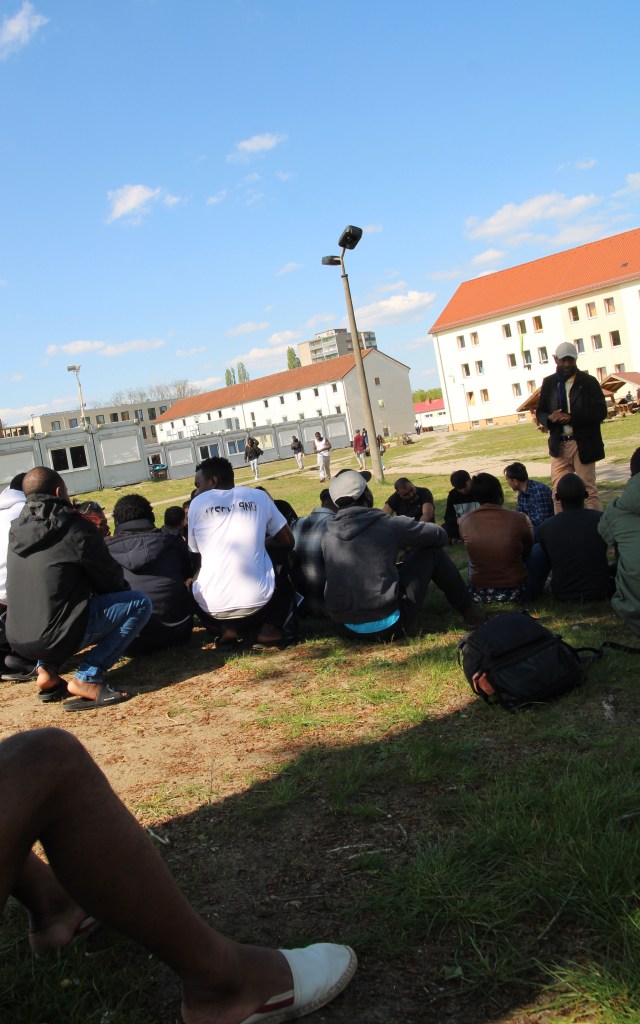
Dieses Bild hängt mit folgender Bildunterschrift im Refugees Emancipation Community Center:
At the reception center located in Eisenhüttenstadt there are many people who have doubts and questions about their asylum application processes. Misinformation generates fear, frustration and insecurity; people live in constant fear of deportation.
In der Aufnahmeeinrichtung in Eisenhüttenstadt gibt es viele Menschen, die Zweifel und Fragen zu ihrem Asylantragsverfahren haben. Fehlinformationen sorgen für Angst, Frustration und Unsicherheit; die Menschen leben in ständiger Sorge vor der Abschiebung.
 ≠ transformation